


Rust-powered, memory-bounded clustering for large embeddings & tabular streams. It compresses raw data into numerically stable BETULA microclusters, then runs the clustering head on the compressed representation — k-means · GMM (diagonal & full) · Ward · spectral · Leiden community detection · directional (von Mises–Fisher / spherical) · HDBSCAN-CF · scale-space modes · Mapper — so cost scales with the microcluster count, not
N. Streamingpartial_fit, a scikit-learn API, from-scratch Rust core + PyO3, no LAPACK or SciPy at runtime.
pip install betula-clusterVerified: a 213-case Python suite at 100% wrapper coverage + 185 Rust tests,
clippy -D warnings + fmt clean across all feature sets, CI on CPython 3.11–3.14 (one abi3 wheel).
Measured against scikit-learn on StandardScaler-normalized data, each method in its own subprocess
with peak RSS sampled from /proc/self/statm. Full methodology, every metric, and all tables (wins
and losses) live in bench/RESULTS.md.
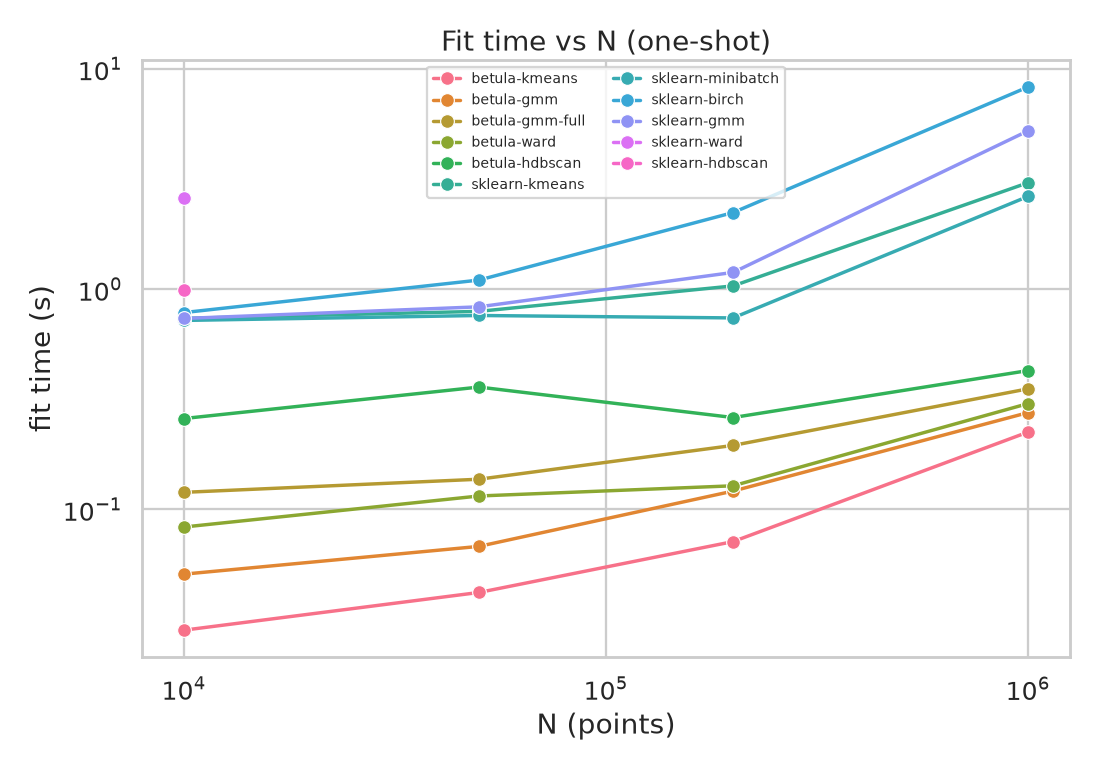
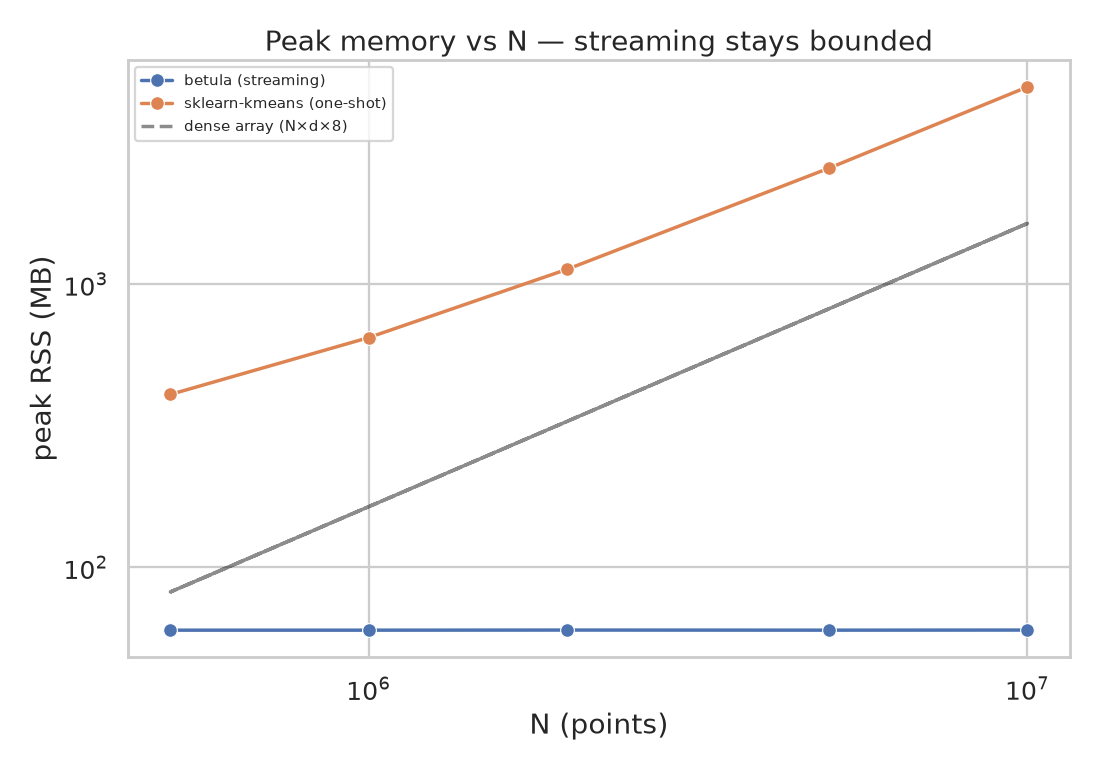
- ⚡🪶 Always faster — and lighter — at scale (the unconditional win). betula labels 1 M points in 0.22 s: 13× faster than scikit-learn KMeans, 23× vs GaussianMixture, 37× vs Birch — and streams 10 M in a flat ~60 MB where an in-core KMeans needs ~5 GB (≈83× less, and the gap grows without bound). This holds for every method at every size.
- 🎯 Quality at parity — or better — on most tasks. betula's k-means is at exact parity with
scikit-learn (blobs 0.861 = 0.861); full-covariance GMM matches it on anisotropic data (0.90 vs
0.90) and beats scikit-learn's GMM on real 64-D
digits(0.51 vs 0.40, via the high-dimensional covariance floor); betula-ward clusters 1 M in 0.30 s whereO(N²)sklearn-ward can't run past ~10 k; and on non-convex moons & circles the spectral and HDBSCAN heads hit ARI 1.00 — spectral matching scikit-learn'sSpectralClusteringat 3–5× the speed. - 🌍 Real data, honest trade-offs. On
digitsbetula-kmeans leads (0.57 vs 0.47); given adequate leaf resolution its diagonal GMM overtakes scikit-learn on hardcovtypetoo (0.096 vs 0.080); it clusters full covtype (581 k rows) ~5.8× faster at matching ARI; in 784-D MNISTnormalize=Truebeats scikit-learn (0.33 vs 0.32). Where a compression method costs some quality — raw-Euclidean k-means in 784-D, HDBSCAN on overlapping blobs —bench/RESULTS.mdreports it rather than hides it.
 |
 |
|---|---|
| Phase-3 clusters only the ~2 000 leaf microclusters, not the raw points, so every head finishes 1 M points in under ½ s. | The CF-tree is capped by max_leaves, so streaming memory stays flat — it clusters data larger than RAM. |
Who it's for: practitioners clustering large embedding or tabular datasets — in batch or as a stream — who need bounded memory and the numerical stability that classic BIRCH and in-core scikit-learn don't provide together.
Clustering libraries tend to either not scale (full GMM/HDBSCAN on raw points), lose precision
(classic BIRCH computes variance as SS − ‖LS‖²/n, which catastrophically cancels far from the
origin), or blow up in memory (BIRCH-family subcluster explosion in high dimensions). betula-cluster
addresses all three:
- Numerically stable — clustering features
(n, μ, S)via Welford / Chan updates; the covariance is PSD by construction. Classic BIRCH loses all digits near coordinate1e7; betula does not. - Memory-bounded by design — the CF-tree caps its leaves (
max_leaves) and rebuilds, so it never explodes; streaming memory is flat inNand clusters data larger than RAM. - Complete — one stable engine spanning k-means / GMM (diag & full) / Ward / spectral / Leiden
community detection / HDBSCAN-style / Mapper, with streaming
partial_fit, a scikit-learn API, and dataset-structure inspection.
The math (stable CF, the expected-log GMM E-step, distance derivations, relation to BIRCH/BETULA) is
written up — verified symbolically and numerically — in docs/MATH.md.
Reach for betula-cluster when the data is large or streaming, memory must stay bounded, you want
fast predict on new points, or you want one numerically stable engine spanning k-means / GMM / Ward /
density / topology plus dedup / outliers / representatives — especially on embeddings and tabular
streams.
Use raw scikit-learn instead when N fits comfortably in RAM and you want the exact point-level
algorithm with no compression: at small N the two-phase overhead removes the speed edge, and raw
HDBSCAN is stronger on overlapping density. betula-cluster trades a CF-compression approximation for
scale and bounded memory — if you need neither, a plain in-core clusterer is simpler.
pip install betula-cluster            # prebuilt abi3 wheels, CPython 3.11–3.14
pip install 'betula-cluster[tune]'    # + Optuna backend for memory-aware tuning
NumPy is the only runtime dependency — no SciPy, LAPACK, or BLAS. Prebuilt wheels ship for Linux
(x86-64 + aarch64), macOS (Intel + Apple Silicon), and Windows (x64); one abi3 wheel covers every
supported Python. Building from source needs a Rust toolchain — maturin develop --release (or
pip install .) in a clone.
import numpy as np
import betula_cluster

X = np.random.default_rng(0).normal(size=(100_000, 10))

labels = betula_cluster.fit_predict(X, n_clusters=10, method="kmeans")
labels = betula_cluster.fit_predict(X, n_clusters=0, feature="full", method="gmm-full")  # auto-k via BIC
labels = betula_cluster.fit_predict(X, n_clusters=8, method="spectral", threshold=0.0)   # non-convex / manifold
labels = betula_cluster.fit_predict(X, method="leiden", threshold=0.4)                    # graph communities; count auto-discovered
labels = betula_cluster.fit_predict(X, method="hdbscan", min_cluster_size=25)            # HDBSCAN-CF; -1 = noise
labels = betula_cluster.fit_predict(X, n_clusters=10, method="vmf")                       # directional / cosine (input auto-L2-normalized)
Streaming / out-of-core — feed chunks, finalize, predict; memory stays bounded by max_leaves:
est = betula_cluster.Betula(method="gmm", memory_budget_mb=512)
for chunk in stream_of_arrays:        # each chunk is a 2-D float32/float64 array
    est.partial_fit(chunk)
est.partial_fit()                     # finalize the global clustering over everything seen
labels = est.predict(X_query)
Robustness — the CF-tree is insertion-order sensitive, so consensus clusters several random
permutations and votes, returning a consensus labelling plus a per-point stability score (any
partitional head — kmeans / gmm / ward / spectral):
res = betula_cluster.consensus(X, n_clusters=10, n_runs=5, method="kmeans", n_jobs=-1)  # -1 = all cores
res.labels           # (n,) consensus label per point
res.confidence       # (n,) in [0, 1] — per-point agreement across runs (1.0 = every order agrees)
res.mean_confidence  # scalar robustness summary
Memory-aware hyperparameter tuning (tune, optional Optuna), Mapper topology (mapper),
semi-supervised constraints (COP-KMeans), mixed numeric+categorical (KPrototypes), streaming
density (DenStream / DbStream), the O(nnz) sparse-native path (fit_predict_sparse),
CF-weighted NMF for nonnegative data (projection="weighted-nmf", or "weighted-nmf-kl" for counts),
quantile
sketches, scipy.sparse input, threshold="auto", soft assignment / coresets / diagnostics / drift
snapshots / active-learning batches, the Rust API, and the CLI — all in the
usage guide.
Stable core — production-ready:
- Clustering heads — weighted k-means (Hamerly), GMM (diagonal & full covariance, BIC auto-
k), exact Ward HAC, spectral (non-convex / manifold), Leiden graph community detection (auto community count,resolution/ CPM, optional covariance/manifold-aware affinity), and directional spherical k-means / von Mises–Fisher mixtures for L2-normalized embeddings (cosine geometry), all over the numerically stable BETULA CF-tree. - Streaming —
partial_fitat bounded memory (max_leaves/memory_budget_mb), EWMAdecay. - scikit-learn API —
fit/predict/fit_predict,get_params/set_params(works withPipeline/clone/GridSearchCV); typed abi3 wheel,save/load+ pickle, reusable Rust core. - Inspection & robustness —
predict_proba, coresets, microcluster/cluster geometry, outliers, near-duplicates, representatives, diagnostics, andconsensus(per-point stability across insertion-order permutations). - Tuning —
tune: memory-aware hyperparameter search with a quality / memory / speed Pareto mode; NumPy-only, optional Optuna backend (pip install 'betula-cluster[tune]').
Experimental / evolving — useful today, API may still move:
- Density & topology — HDBSCAN-CF (density over microclusters), scale-space Morse-persistence
density-mode clustering (
method="scale-space"— nok, no bandwidth), and a Mapper topological skeleton (mapper/mapper_stability). - Structured-covariance GMM — a three-rung Toeplitz ladder:
method="gmm-toeplitz"(banded AR),"gmm-toeplitz-full"(general positive-definite Toeplitz covariance), and"gmm-toeplitz-gs"(full-order Gohberg–Semencul MLE precision): covariance-shape clustering for ordered, stationary signals (time-series windows, trajectories, sensor waveforms), well-posed where full covariance is singular (N_k ≪ d) and a diagonal model ignores neighbour correlation; the-fullhead captures structure beyond a low-order AR (e.g. a long-lag echo), the-gshead fits a likelihood-optimal precision with a cheaper E-step than full at larged. - More heads & data —
DenStream/DbStreamevolving-stream density, mergeableKllSketch/DdSketchquantiles,scipy.sparse(O(nnz), never densified), mixed numeric+categorical (KPrototypes), COP-KMeans constraints, robust (Huber) insertion, drift snapshots, dependency-free CLI.
Full reference: docs/FEATURES.md.
Seventeen executed, plotted notebooks — one per capability — live in
examples/ (render on GitHub):
- Core — quickstart, embeddings & inspection, streaming & persistence, method comparison, Mapper topology.
- Streaming density —
DenStream&DbStream. - Mixed data —
KPrototypes. - Sketches —
KllSketch&DdSketch. - Semi-supervised — must-link / cannot-link.
- Sparse / high-dim —
scipy.sparse+fit_predict_sparse. - Soft assignment & coresets —
predict_proba, coresets, diagnostics. - Production ops — drift, active learning, robust, memory budgets.
- Graph & geometry — graph clustering (Leiden), directional embeddings (vMF / spherical), geometry-aware clustering (covariance / manifold).
- Time-series —
gmm-toeplitzAR/Toeplitz covariance for stationary signals. - Nonnegative data —
projection="weighted-nmf"CF-weighted NMF on topic counts.
And six end-to-end use cases (each scored against ground truth):
- 🧹 Embedding dedup — collapse a repost-heavy corpus to representatives.
- 🚨 Log anomaly detection — batch outlier scoring + streaming
DbStreamflags. - 👥 Customer segmentation — mixed RFM + categorical personas with
KPrototypes. - 🧠 RAG corpus curation — junk removal, topic coherence, and topic-leakage detection via Mapper.
- 🔢 Real-data clustering — handwritten digits, ARI parity + centroid/exemplar inspection.
- 🌐 Graph communities — Leiden community detection on a network, scored against planted communities.
- Usage guide — runnable snippets for every interface.
- Features — full capability reference + crate architecture.
- Math — stable CF, GMM E-step, distance derivations, relation to BIRCH/BETULA.
- Benchmarks — methodology, every metric, all tables, honest wins & losses.
- Design — internal design, invariants, and testing strategy.
Verified: 185 Rust unit + 4 integration tests + a 213-case Python suite at 100% wrapper
coverage (Rust ≥95%, CI-enforced), clippy -D warnings + fmt clean across all feature sets, on
Python 3.11–3.14 (single abi3 wheel).
Honest scope — inherent to a CF-compression + streaming design, not bugs:
- Insertion-order sensitive — like every BIRCH-family streaming method, the labels depend on the order points arrive (the parallel build differs from the serial one, as a different order would).
threshold/max_leavesare real hyperparameters — they trade compression against resolution;n_rebuilds_/threshold_expose thrashing / over-coarsening.- CF-level heads approximate raw-data clustering — Phase-3 runs on the
M ≪ Nmicroclusters; quality degrades when clusters overlap at the compression scale. Mitigation: more leaves. - HDBSCAN-on-CF ≠ raw-point HDBSCAN — mass-aware HDBSCAN over microclusters: fast and close, but an approximation (weaker on overlapping blobs; see the benchmarks).
- The expected-log GMM optimizes a CF-level objective, not pointwise EM (a deliberate, measured choice for coarse CFs).
- Frequent-Directions is an approximate low-rank covariance (exact only up to its rank
ℓ).
If betula-cluster supports your research, please cite the software and the underlying
algorithms it implements. Machine-readable metadata (including the method references) lives in
CITATION.cff — GitHub's
"Cite this repository" renders it directly.
@software{gradina_betula_cluster,
  author  = {Gradina, Ilia},
  title   = {betula-cluster: numerically stable {BETULA} clustering with a {Rust} core},
  year    = {2026},
  version = {0.5.0},
  doi     = {10.5281/zenodo.21427331},
  license = {MIT},
  url     = {https://github.com/ilgrad/betula-cluster}
}
betula-cluster is an independent implementation (with extensions); the algorithms are due to BETULA — Lang & Schubert, Information Systems (2022), doi:10.1016/j.is.2021.101918 — building on BIRCH — Zhang, Ramakrishnan & Livny, SIGMOD (1996), doi:10.1145/233269.233324.
MIT © Ilia Gradina