


img2bez traces raster glyph images into bézier outlines and writes them directly into UFO font sources.
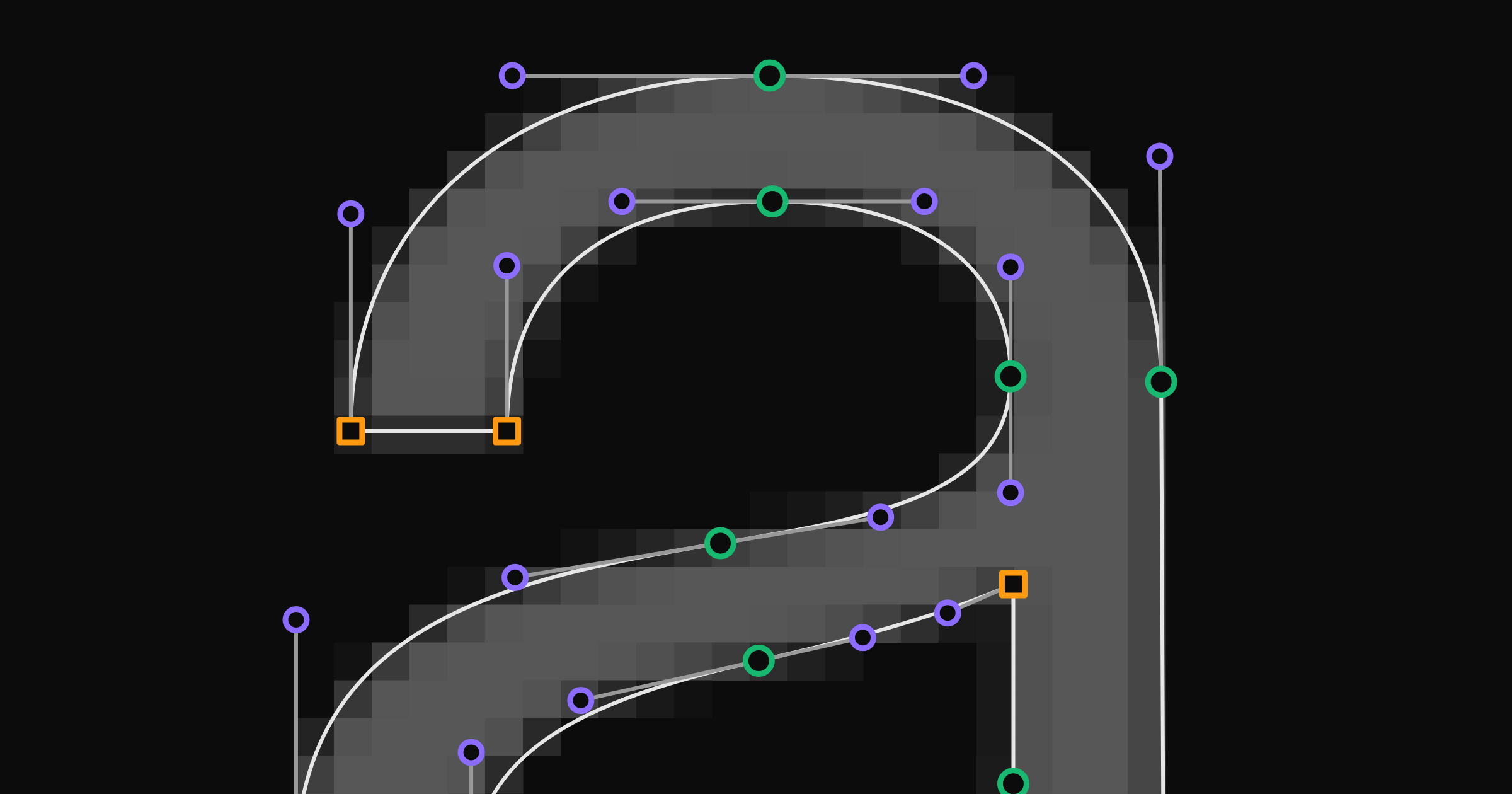
Most autotracers reproduce a glyph's silhouette and leave the outline structure to a human. img2bez aims for the structure a font source needs: points at extrema with horizontal or vertical handles, straight segments as lines, points at inflections, smooth joins harmonized toward G2, and the minimum number of points that render the shape. Traces run in milliseconds on a CPU. Built on kurbo and norad from the Linebender ecosystem.
Read the blog post for the design rationale and an interactive in-browser demo.
Not yet published to crates.io. Install from GitHub for now:
cargo install --git https://github.com/eliheuer/img2bez            # the CLI
cargo add --git https://github.com/eliheuer/img2bez img2bez # as a library# Trace a glyph image into a UFO source (created if it doesn't exist)
img2bez --input glyph.png --output MyFont.ufo --name A --unicode 0041
# With font metrics and grid snapping
img2bez --input glyph.png --output MyFont.ufo --name A --unicode 0041 \
--target-height 1024 --y-offset -256 --grid 2img2bez --help is the authoritative flag list, including the masters
(interpolation-compatible variable-font masters) and new-font
subcommands. Key flags: --profile wild|clean|photo (source-class
preset), --accuracy (fit tolerance, font units), --mode smooth|line
(shape constraint), --format ufo|glif|json|svg.
use std::path::Path;

use img2bez::{trace_glyph_path, FontMetrics, Profile, TraceOptions};

let opts = TraceOptions::for_profile(Profile::Clean)
    .with_em_height(1088.0)
    .with_grid(2);
let metrics = FontMetrics::from_target_height(1088.0, -256.0)
    .with_advance(600.0);

let glyph = trace_glyph_path(
    Path::new("glyph.png"), "A", &['A'], &opts, &metrics,
)?;

// The same Glyph model serializes to GLIF, JSON, or SVG.
std::fs::write("A.glif", glyph.to_glif())?;

# Ok::<(), Box<dyn std::error::Error>>(())
Designed to embed: trace_glyph takes image bytes and returns a
Glyph with no filesystem access; output is deterministic (cache by
input hash); options are per call; a lean build
(--no-default-features --features ufo) drops the CLI and renderer
dependencies. WASM bindings run the identical pipeline in the
browser; mcp/ exposes it to AI agents as an MCP server.
 Input image (grayscale)
      |
 1. Sub-pixel boundary extraction — marching squares at the
    threshold iso-level; the anti-aliasing carries ~0.1px accuracy
 2. Structure detection — corners, straights, tangent points,
    extrema, inflections from the curvature signal
 3. Constrained cubic fitting — tangent directions fixed (exactly
    H/V at extrema), handle lengths solved, candidate structures
    scored against the source pixels
 4. Font cleanup — contour direction, grid snapping, H/V handle
    correction, G2 harmonization, corner reconstruction
      |
 UFO / GLIF / JSON / SVG
Optional learned models (tiny decision heads, a few KB each, plain Rust
inference) can replace individual structural judgment calls. They only
choose between structures the procedural pipeline proposes — all
drawing stays procedural — and they are off by default
(IMG2BEZ_SITE_HEAD=1, or siteHead in the wasm config). The
demo has a live rules-vs-learned
toggle.
The eval harness traces clean renders of a reference font and scores the result against the original UFO outlines (point count and placement, line/curve structure, H/V handles). Across basic Latin (a–z, A–Z, 0–9): mean structural score 0.964, 12 glyphs exact, 62/62 pass. Try your own images in the demo.
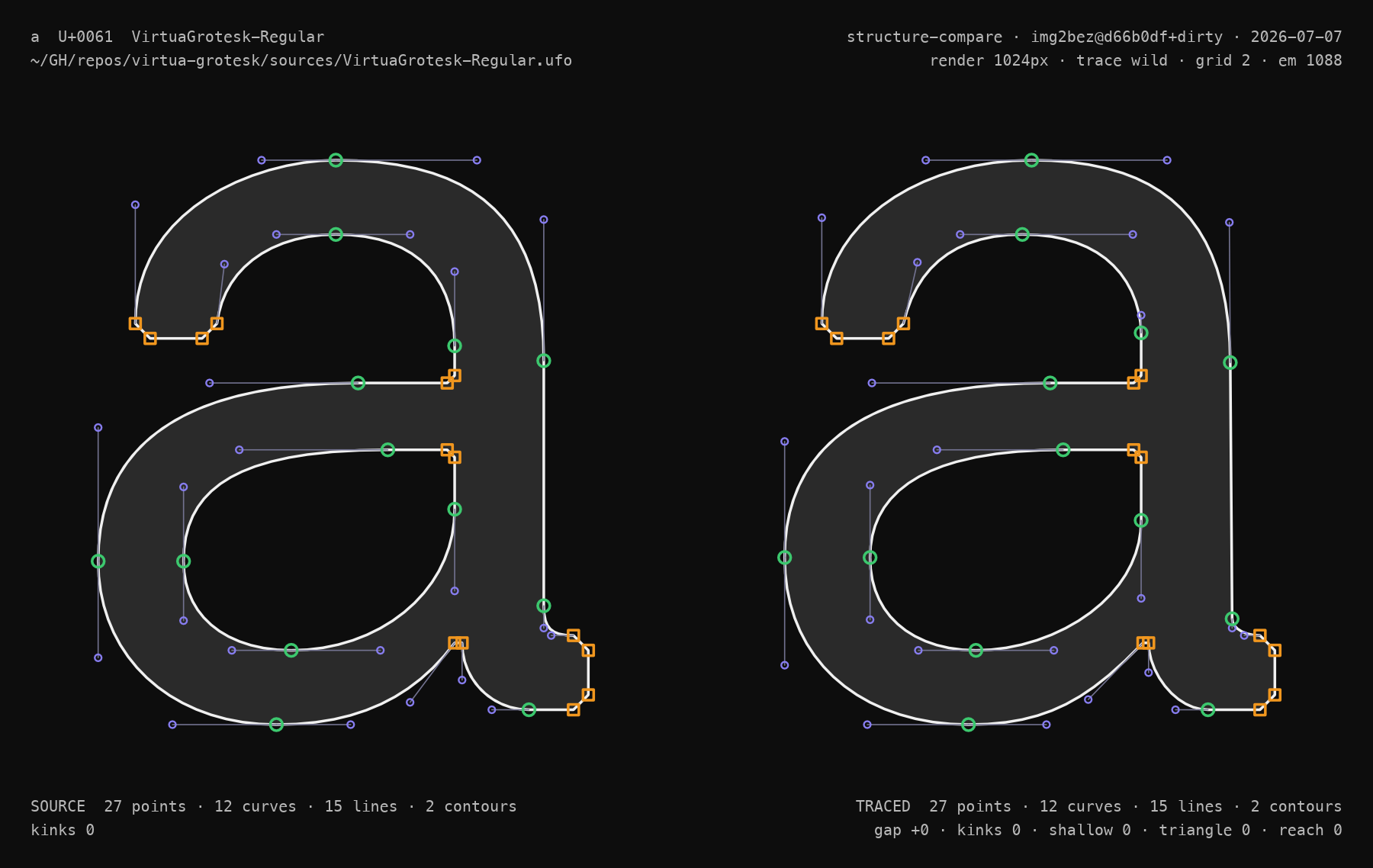
A structure-compare sheet: the source font's outlines (left), the
trace of a 1024px rendering of them (right) — same 27 points, same
structure.
Per-glyph scores
| Glyph | Score | Glyph | Score | Glyph | Score | Glyph | Score |
|---|---|---|---|---|---|---|---|
| i | 1.000 | j | 0.987 | 6 | 0.967 | D | 0.946 |
| o | 1.000 | q | 0.987 | 9 | 0.967 | S | 0.943 |
| v | 1.000 | z | 0.986 | B | 0.965 | b | 0.939 |
| E | 1.000 | P | 0.986 | g | 0.964 | p | 0.938 |
| F | 1.000 | w | 0.982 | U | 0.964 | l | 0.934 |
| H | 1.000 | J | 0.982 | n | 0.960 | 2 | 0.934 |
| I | 1.000 | W | 0.982 | h | 0.958 | Y | 0.931 |
| L | 1.000 | x | 0.981 | u | 0.958 | s | 0.927 |
| O | 1.000 | R | 0.981 | X | 0.958 | m | 0.922 |
| T | 1.000 | C | 0.978 | 5 | 0.958 | y | 0.918 |
| V | 1.000 | a | 0.972 | d | 0.957 | 0 | 0.915 |
| 1 | 1.000 | 4 | 0.971 | Q | 0.957 | e | 0.909 |
| 8 | 0.993 | A | 0.969 | c | 0.954 | r | 0.863 |
| f | 0.991 | 3 | 0.968 | N | 0.950 | 7 | 0.779 |
| t | 0.991 | k | 0.967 | Z | 0.950 | ||
| M | 0.990 | K | 0.967 | G | 0.948 |
| Feature | Default | Description |
|---|---|---|
ufo |
yes | UFO output via norad |
cli |
yes | The img2bez binary (implies ufo and render) |
parallel |
yes | Per-contour parallelism via rayon |
render |
yes | PNG rendering and raster IoU via tiny-skia |
Debug environment variables
Prefix a command with VAR=1 for a single run, e.g.
IMG2BEZ_DEBUG_FIT=1 img2bez ...:
| Variable | Effect |
|---|---|
IMG2BEZ_DEBUG_FIT |
Pipeline splits, fit errors, refine decisions |
IMG2BEZ_DEBUG_CORNERS |
Corner decisions; site-head zone scores |
IMG2BEZ_DEBUG_FLATS |
Junction-flat decisions |
IMG2BEZ_DEBUG_SIMPLIFY |
Point-merge accept/reject reasons |
IMG2BEZ_DEBUG_TANGENT / _WELD / _ARCCHAIN |
Tangent, weld, arc-chain decisions |
IMG2BEZ_DEBUG_NO_CLEANUP |
Skip all post-processing |
IMG2BEZ_DEBUG_PIXELDIFF |
Save a 1:1 pixel diff image |
IMG2BEZ_DEBUG_JOINT / _JOINT_EXTREMA |
Joint masters decisions |
IMG2BEZ_PHOTO_FAIR_DEV |
Photo-profile fairing threshold override |
IMG2BEZ_LOG / IMG2BEZ_LOG_DECISIONS |
Append JSONL trace/decision logs to a path (causes file writes) |
IMG2BEZ_CORNER_HEAD=1 / IMG2BEZ_SITE_HEAD=1 are opt-ins, not debug
switches: they enable the learned heads (the default pipeline is fully
procedural).
The tracer is developed against a measurable loop: render a reference
font, trace it back, score the structural match. The harness and the
structure-compare QA tool (side-by-side sheets like the one above,
for any UFO) live in
eval-harness/
(repository only, not in the published crate). Known gaps:
docs/known-problems.md.
img2bez has been verified to compile with Rust 1.88 and later.
Licensed under either of
- Apache License, Version 2.0 (LICENSE-APACHE or http://www.apache.org/licenses/LICENSE-2.0)
- MIT license (LICENSE-MIT or http://opensource.org/licenses/MIT)
at your option.
Unless you explicitly state otherwise, any contribution intentionally submitted for inclusion in the work by you, as defined in the Apache-2.0 license, shall be licensed as above, without any additional terms or conditions.