Tell search engines your pages changed, the moment they change.
A self-hosted web UI and CLI for the IndexNow protocol. Manage several sites and their keys in one place, pull URLs from a sitemap, file, or paste, and watch each submission report progress and errors as it runs.
MIT licensed. Runs on your machine or in a container. No account, no third party.
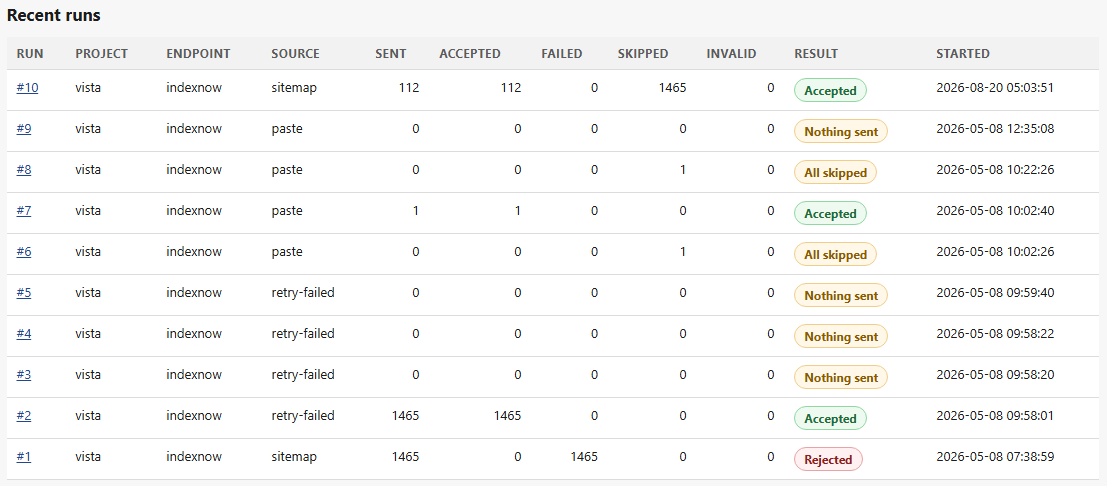
Every run is recorded. Run #10 re-submitted the same sitemap and sent only the 112 URLs that were new, skipping 1,465 already accepted.
Search engines normally find your changes by re-crawling your site and hoping to notice. That can take days or weeks, and most of the crawling is wasted on pages that did not change.
IndexNow inverts it. You tell the engines directly: these URLs changed, come look. It is an open protocol, and the whole thing is three moving parts:
- A key. Any random string, 8–128 characters of
A-Z a-z 0-9 -. - A key file. That key, saved as
<key>.txtat the root of your site, sohttps://www.example.com/<key>.txtreturns it. This is how an engine proves the submission came from someone who controls the domain. - A POST. Your host, your key, and a list of up to 10,000 changed URLs.
Put the key file at your site root. Its folder decides what it authorizes: a key
at https://example.com/public/key.txt can only submit URLs under
https://example.com/public/, so a root-level key file is the only one that covers
the whole site. This tool checks that rule before submitting and tells you which
folder would work.
Submit once and it reaches every participating engine — they share submissions with each other. You do not repeat the call per engine.
It does not guarantee indexing. It removes the discovery delay and tells the engines where to spend their crawl budget. Whether a page then gets indexed is still up to them.
Per indexnow.org, the participating engines are:
| Engine | |
|---|---|
| Microsoft Bing | Also feeds Copilot, DuckDuckGo, Ecosia, Yahoo and others that use the Bing index |
| Yandex | |
| Seznam.cz | Dominant in the Czech Republic |
| Naver | Dominant in South Korea |
| Yep |
Google does not participate. It evaluated IndexNow and has not adopted it. Use Search Console and sitemaps for Google. If you are only targeting Google, this tool will not help you.
The POST itself is one HTTP request. Doing it properly, repeatedly, across several sites, is the part that gets tedious — and that is what this handles.
- No duplicate submissions. Every URL is tracked in SQLite. Re-run the same
sitemap and only genuinely new URLs go out. URLs are canonicalized before
comparison, so
HTTPS://WWW.Example.com/Aandhttps://www.example.com/Acount once. - Multiple sites. Each project has its own host, key, key-file location, default sitemap, and endpoint. Add and edit them in the UI.
- Key verification. One click fetches your key file the way an engine will, and tells you if it is missing or does not match. This is the single most common reason submissions fail.
- Errors you can act on. Every rejected batch is stored with its HTTP code and what that code actually means. Every skipped URL records why.
- Live progress. Long runs show a progress bar and a running log, not a spinner.
- Retry and close-out. Failed URLs are listed with their ids; retry all or a subset, or mark them resolved if you confirmed indexing another way.
- CLI for automation. Every UI action has a command, exits non-zero on failure, and drops straight into cron or Task Scheduler.
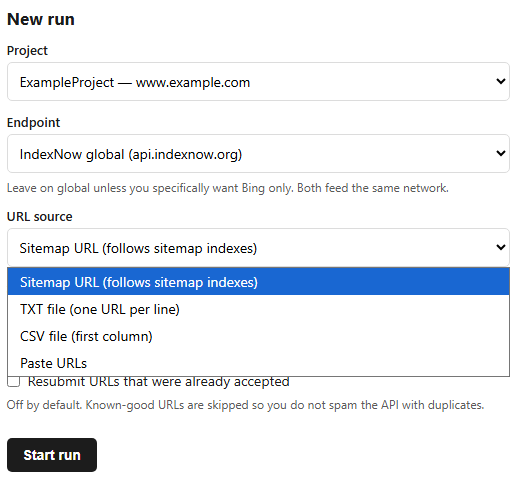
| Source | Notes |
|---|---|
| Sitemap URL | Follows sitemap indexes up to 3 levels. Handles .xml.gz. |
| TXT file | One URL per line. Any line endings. |
| CSV file | First column. A header row is skipped automatically. |
| Paste | One URL per line. |
pipx install indexnow-tool
indexnow
indexnow with no arguments starts the web UI and prints its address. The database
goes to ~/.indexnow/indexnow.db.
git clone https://github.com/dawid-ai/indexnow-tool
cd indexnow-tool
echo "AUTH_PASSWORD=pick-a-password" > .env
docker compose up -d
Open http://localhost:8787. Data lives on the indexnow-data volume. The compose
file publishes to 127.0.0.1 only — read Security before changing that.
git clone https://github.com/dawid-ai/indexnow-tool
cd indexnow-tool
python -m venv .venv && . .venv/bin/activate    # Windows: .venv\Scripts\activate
pip install -e .
python main.py
Requires Python 3.10 or newer.
- Open the UI and go to Projects & keys.
- Add a project: a name you choose, the host (
www.example.com), and your key. Do not have a key? Any random 8–128 character string ofA-Z a-z 0-9 -works. - Save that key in a file named
<key>.txt, containing nothing but the key, and upload it to your site root sohttps://www.example.com/<key>.txtserves it. - Press Verify key.
- Go to Submit, pick the project and a source, and start a run.
Step 4 is the one people skip. A missing or mismatched key file gives you a 403,
and in the worse case submissions look accepted and are silently ignored. Every run
re-checks it anyway and stops before submitting if it is wrong.
Leave Key file URL empty unless the key file is somewhere other than the site
root. Empty is correct for https://www.example.com/<key>.txt, and it is what you
want in almost every case.
- URLs whose host does not match the project are rejected before any request. IndexNow rejects an entire batch on a host mismatch, so one stray URL would otherwise take down the whole submission.
- A URL the API already accepted is skipped. Tick Resubmit URLs that were already accepted to override.
- A URL that failed, or was stranded by an interrupted run, is picked up again next time.
- Batches are 1,000 URLs, well under the 10,000 limit, so progress is visible and one rejected batch does not fail the rest.
indexnow                                      # start the web UI (default command)
indexnow projects                             # list projects
indexnow project-add --name demo --host www.example.com --key <key>
indexnow verify-key --project demo            # non-zero exit if the key file is wrong
indexnow status                               # recent runs as JSON

indexnow run --project demo --source sitemap --sitemap-url https://www.example.com/sitemap.xml
indexnow run --project demo --source txt --file urls.txt --endpoint bing
indexnow run --project demo --source paste --paste "https://www.example.com/a"
indexnow run --project demo --source sitemap --force    # resubmit known URLs

indexnow retry-failed --project demo --ids 12,13
indexnow retry-failed --project demo --all
indexnow mark-success --project demo --ids 12,13
indexnow export --project demo --status failed > failed.csv
run and retry-failed stream the same log the UI shows and exit non-zero if
anything failed.
retry-failed and mark-success require either --ids or --all. An empty
selection never means "everything".
From a source checkout, use python main.py in place of indexnow.
0 6 * * * indexnow run --project mysite --source sitemapAlready-submitted URLs are skipped, so running this daily only sends what changed.
This tool stores IndexNow keys in plaintext in its SQLite database. Anyone who can reach the UI can read them and submit URLs for your domains.
- On
localhostwith no password, it is a local tool and needs nothing more. - Anywhere else, set
AUTH_PASSWORD. The app refuses to start on a non-loopback host without it.
Authentication is one shared password and a signed, HttpOnly, SameSite=Lax
session cookie. There are no user accounts. That fits a single-operator tool and is
deliberately not enough for a shared multi-tenant service.
- Set
AUTH_PASSWORDto something long. - Set
AUTH_SECRETto a long random string. Without it a new one is generated each start, signing everyone out on restart — and a second worker or replica would reject the first one's cookies. - Terminate TLS in a reverse proxy and set
AUTH_COOKIE_SECURE=true. - Only then change the compose port mapping from
127.0.0.1:8787:8787to8787:8787.
Report security issues through a private GitHub security advisory, not a public issue.
| Variable | Default | Purpose |
|---|---|---|
DB_PATH |
data/indexnow.db in a checkout, else ~/.indexnow/indexnow.db |
SQLite file |
DEFAULT_ENDPOINT |
indexnow |
indexnow or bing |
DEFAULT_UI_PORT |
8787 |
First port tried; scans upward for a free one |
AUTH_PASSWORD |
unset | UI password. Required off loopback |
AUTH_SECRET |
generated per start | Signs session cookies |
AUTH_COOKIE_SECURE |
false |
Set true when serving over HTTPS |
Read from the environment or a .env file. See .env.example.
Endpoints. indexnow posts to https://api.indexnow.org/indexnow, which shares
with every participating engine — that is the one you want. bing posts directly to
https://www.bing.com/indexnow if you specifically want Bing only. Set it per
project, or per run with --endpoint.
Projects defined the older way, with PROJECTS and PROJECT_<NAME>_* variables, are
imported on startup only when no project of that name exists, so UI edits are never
overwritten.
- Max 10,000 URLs per POST; this tool sends 1,000 at a time.
- Key format validated as 8–128 chars of
A-Z a-z 0-9 -. - Host consistency enforced against the project host.
200and202count as success.400,403,404,422,429reported with what each means.429retries and honorsRetry-After; network errors retry up to 3 times.
Reference: documentation · FAQ · Bing
pip install -e ".[dev]"
pytest
Tests cover URL canonicalization, host validation, sitemap index detection, dedupe rules, selection-scope guards, schema migration from the first release, and session token forgery. They make no network calls.
Do not point run or retry-failed at a real project while testing — both hit the
live API. Stub indexnow_tool.service.submit_url_batch to exercise the run pipeline
offline.
CLAUDE.md documents the architecture and the invariants that encode past bugs.
Read it before changing the dedupe or scope logic.
Issues and pull requests welcome.
MIT — see LICENSE.