A set of Maple functions which implement the algorithm described in [1]; namely: given a pair of real symmetric matrices with symbolic entries and a desired arrangement of their eigenvalues, compute a quantifier-free condition on the entries of the matrices so that their eigenvalues are arranged in the given way.
This implementation uses the theory of generalized real root counting and the signature of matrices. See ec-symmetry for an alternative algorithm which solves the same problem.
The main function is ECsig.
# In : F, G, symbolic real symmetric matrices.
# Out: Csig, Asig such that c = EC(F,G) iff c = Csig . sig(Asig)
Let
  F = [ 1  -2  ]       G =  [ 1        p^2+p  p + 1 ]
      [ -2  1  ] ,          [ p^2 + p  -p     p - 1 ]
                            [ p + 1    p - 1  p     ]
where p is a parameter. Suppose we would like to find a
quantifier-free condition
on p so that the eigenvalue configuration of F and G is
(1,1); i.e., the eigenvalues of F (red) and G (blue) are
arranged as follows:

Make sure that Maple's working directory is the same directory as the
ECSignature.mpl script. In a Maple worksheet, enter the following.
restart:
with(LinearAlgebra):
read("ECSignature.mpl");
F := Matrix([[1,-2],[-2,1]]);
G := Matrix([[1, p^2 + p, p + 1], [p^2 + p, -p, p-1], [-p + 1, p - 1, p]]);
Csig, Asig := ECSig(F,G);
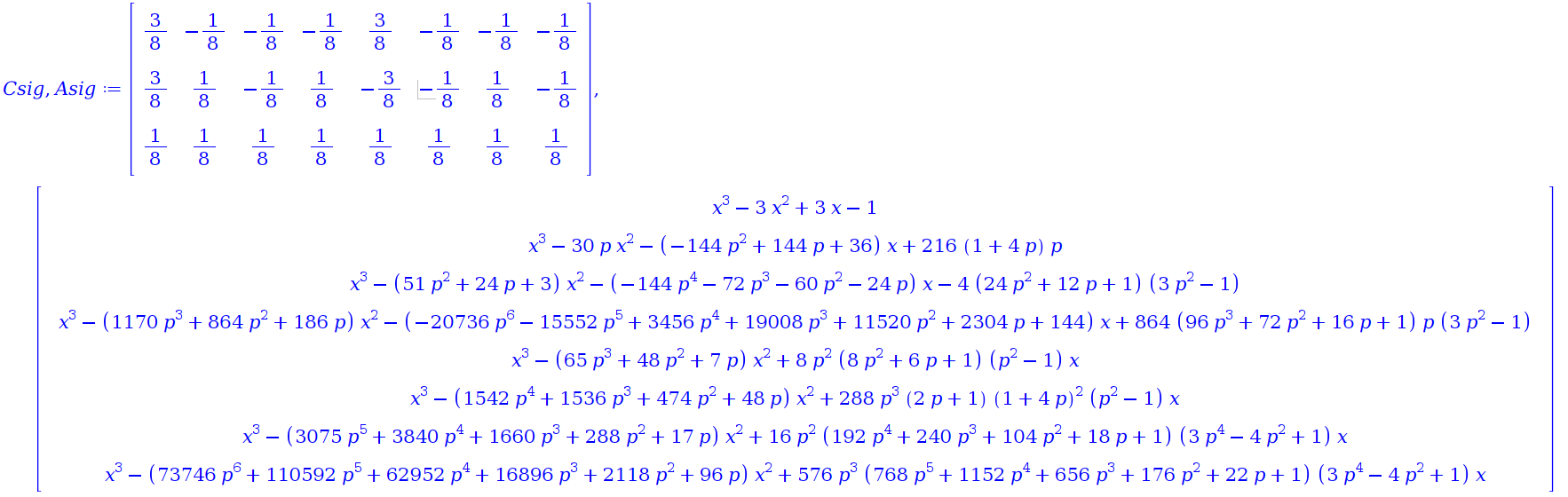
The outputs are a numeric matrix Csig and a column vector Asig of
polynomials in p, such that if c is any valid eigenvalue
configuration, then
c = Csig . sig(Asig),
where sig(Asig) means to take the signature (difference between
number of positive roots and negative roots) of each entry in Asig.
- Hong, Hoon, Daniel Profili, and J. Rafael Sendra. "Conditions for eigenvalue configurations of two real symmetric matrices (signature approach).". SIAM Journal on Matrix Analysis and Applications (pending). (2026).