


Tenant-fair LLM inference on one GPU. Sits in front of vLLM/SGLang, rate-limits per tenant at admission, and keeps a quiet user fast while a noisy neighbor floods the same engine.
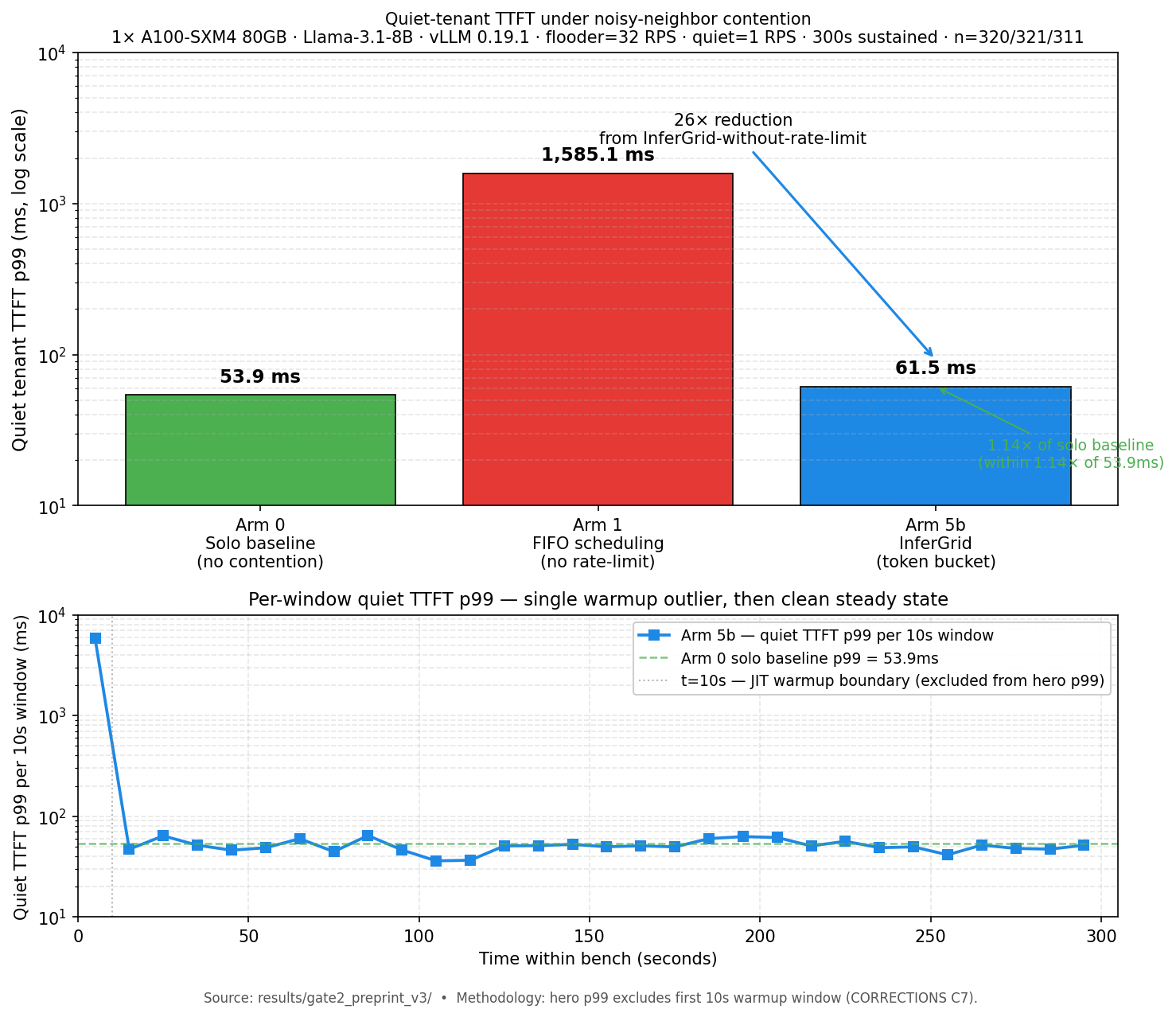
Hero number. A100-SXM4, Llama-3.1-8B, vLLM 0.19.1, two tenants sharing one engine, 300 s sustained:
| Quiet user TTFT p99 | |
|---|---|
| Solo (no contention) | 53.9 ms |
| FIFO under flooder (no rate-limit) | 1,585 ms (29x starvation) |
| kvwarden token-bucket under flooder | 61.5 ms (1.14x solo) |
Ten lines of YAML. No application code change. Raw artifacts: results/gate2_preprint_v3/.
pip install kvwardenkvwarden does not bundle vLLM. Install an engine separately, then let kvwarden spawn and proxy it.
# 1. Install kvwarden + the engine.
pip install kvwarden
pip install vllm  # needs a GPU box; see vLLM docs for your CUDA stack

# 2. Start kvwarden. It launches vLLM as a subprocess per the model list
#    in the config and exposes one OpenAI-compatible endpoint.
kvwarden serve --config configs/quickstart_fairness.yaml

# 3. In another shell, wait for /health and send two tenants at the same model.
until curl -fs localhost:8000/health > /dev/null; do sleep 2; done

curl localhost:8000/v1/completions -H "X-Tenant-ID: noisy" \
  -d '{"model":"llama31-8b","prompt":"Hello","max_tokens":64,"stream":true}'
curl localhost:8000/v1/completions -H "X-Tenant-ID: quiet" \
  -d '{"model":"llama31-8b","prompt":"Hello","max_tokens":64,"stream":true}'

# 4. Watch the token bucket fire and the engine queue stay composed.
curl localhost:8000/metrics | grep -E "tenant_rejected|admission_queue_depth"
First call returns 503 until vLLM finishes loading (30-90 s on A100 for an 8B). The config at configs/quickstart_fairness.yaml is heavily commented; every knob traces back to a specific experiment.
A two-service compose bundle brings up vLLM + kvwarden with one command. Requires a Linux GPU host with the NVIDIA Container Toolkit; CPU-only and Apple Silicon hosts cannot run this end-to-end (vLLM needs CUDA).
export HF_TOKEN=hf_...                      # gated Llama-3.1-8B model
docker compose -f docker/docker-compose.yml up
# in another shell, once both services report healthy (~3 min cold):
curl localhost:8000/v1/completions -H 'X-Tenant-ID: quiet' \
  -d '{"model":"llama31-8b","prompt":"Hello","max_tokens":32}'
Compose pins vllm/vllm-openai:v0.19.1 (the image the hero number was measured against) and serves the bundled docker/quickstart-compose.yaml — same two-tenant token-bucket shape as configs/quickstart_fairness.yaml, port-pinned for the bundle.
| Symptom | Likely cause | Fix |
|---|---|---|
kvwarden doctor reports "SSL trust unavailable" |
macOS stock Python venv missing CA roots | pip install --upgrade certifi, then re-run |
/health returns 503 right after kvwarden serve |
vLLM JIT-compiling the model (30-90 s for an 8B on A100) | Wait, then until curl -fs localhost:8000/health; do sleep 2; done |
/v1/completions returns 401 |
HuggingFace gated-model auth missing | huggingface-cli login, or export HF_TOKEN=... before kvwarden serve |
| Quiet tenant still starved under flooder | rate_limit_rpm too high in config |
Drop the per-tenant rate_limit_rpm in your config; the hero uses 600 with rate_limit_burst: 10 |
| All requests return 429 immediately | rate_limit_burst set tighter than your client's burst |
Raise rate_limit_burst or unset it (default = rate_limit_rpm) |
| vLLM subprocess crashes with CUDA OOM | gpu_memory_utilization too high for the loaded model + KV cache |
Drop the model's gpu_memory_utilization to 0.40 (hero default) and retry |
Address already in use on port 8000 |
Stale daemon or another local service | kvwarden serve --port 8001, or lsof -i :8000 to find the holder |
ModuleNotFoundError: kvwarden after pip install kvwarden |
venv mismatch — installed into the wrong interpreter | python -c "import kvwarden; print(kvwarden.__version__)" to confirm; reinstall in the venv that runs kvwarden |
| Engine pre-load takes >5 min | First-time model download from HuggingFace | Pre-warm the cache: huggingface-cli download <model_id> before kvwarden serve |
If your symptom is not in the table, file an issue with the output of kvwarden doctor and kvwarden serve --log-level DEBUG.
| Tool | Orchestration | Tenant fairness | Engines | Target scale |
|---|---|---|---|---|
| NVIDIA Dynamo | Kubernetes | No | Multi | Datacenter |
| llm-d | Kubernetes | No | vLLM | Datacenter |
| Ollama | None | No | llama.cpp | Single-user |
| kvwarden | None | Yes | vLLM + SGLang | Single-node, 2-8 tenants |
kvwarden is the "shared GPU, a handful of tenants, no cluster" cell. If you already run Kubernetes or you're a single user on your own box, you probably want one of the others.
A thin orchestration layer (~3,500 LOC src) sits between your app and vLLM/SGLang. On request arrival, a per-tenant token bucket decides admit-or-429 before the request reaches the engine queue. Admitted requests flow through a length-bucketed admission controller and a DRR priority scheduler, then out to the engine subprocess kvwarden manages. Engines never see tenant identity; kvwarden does, and that's the entire trick. Multi-model lifecycle (freq+recency eviction, hot-swap) lives at the same layer. The HTTP API is OpenAI-compatible so your client code doesn't change.
Deeper read and the component diagram live in docs/architecture/overview.md.
# Terminal A — start kvwarden on the hero config (vLLM 0.19.1, Llama-3.1-8B).
kvwarden serve --config configs/gate2_fairness_token_bucket.yaml --port 8000

# Terminal B — wait for /health, then run the 300-second bench.
until curl -fs localhost:8000/health > /dev/null; do sleep 5; done
kvwarden bench reproduce-hero --flavor=2tenant
Needs an A100-SXM4 80GB (or equivalent — 1xH100 works) with vLLM 0.19.1 installed. Runtime is about 300 s for the bench plus ~30 s preflight. Output goes to ./kvwarden-reproduce-<timestamp>/report.json with your numbers side-by-side against the published reference so you can file an issue with concrete data if they diverge. Other flavors: --flavor=n6, --flavor=n8. Full doc: docs/reproduce_hero.md.
The same admission mechanism holds on larger models. Gate 2.3 (70B dense, TP=4 on 4x H100) and Gate 2.4 (Mixtral-8x7B MoE, TP=2 on 2x H100) both land quiet-to-solo p50 ratios between 1.07x and 1.94x — the mechanism lives before the engine boundary, so sharding topology, expert routing, and attention shape don't change the fairness picture. Matrix, caveats, and raw bench pointers in docs/launch/frontier_coverage.md. The 8B A100 run is the only one with a single-command reproduce path today; 70B and Mixtral wrappers are a roadmap item.
kvwarden ships tenant-fair admission today. The name still over-promises: nothing in 0.1.x reads or writes the KV cache. The actual trajectory:
- 0.1.x (today): tenant-aware admission — token bucket at the budget gate. Engine-blind to tenants; we put the policy one layer up.
- 0.2 (mid-June): cache-pressure-aware admission. Same gate, now informed by the engine's
vllm:kv_cache_usage_percgauge, so the bucket scales priority by cache load. Still admission, still doesn't touch the cache — but smarter gating. RFC: docs/rfcs/T2-cache-pressure-admission.md. The original "tenant-aware KV eviction" framing for 0.2 was reframed on 2026-04-28 after we verified the eviction scaffold is a shadow ledger no engine reads — see #103 for the supersession trail. - 0.3+ (LMCache substrate): actual per-tenant KV cache management. This is where the name finally becomes literal.
0.2 limitation, surfaced upfront: vllm:kv_cache_usage_perc is labeled only by model_name, not by tenant. 0.2 lets kvwarden react to global cache pressure; it cannot see which tenant is occupying the cache. Per-tenant cache visibility waits on LMCache (0.3+).
If you pip install 0.1.5 expecting KV-cache isolation today, you will not get it; you get admission-gate fairness, which is what the hero number measures.
- #102 T1: Distribution — 10 onboarding installs in week 1
- #103 T2: Name-truth — cache-pressure admission for 0.2; LMCache-based per-tenant cache for 0.3+
- #104 T3: Moat — vllm-project/production-stack router + LiteLLM adapter
- #105 W1: Launch blockers — pre-launch QA + day-0 ops
kvwarden ships opt-in, anonymous install/usage telemetry. First interactive run prompts once; default is no; answer n or hit Enter and nothing is ever transmitted. Opt in and each command sends seven fields: a locally-minted uuid4 install ID, kvwarden version, Python major.minor, OS, bucketed GPU class, command name, and a unix timestamp. No prompts, model names, tenant IDs, or receiver-side IP capture. Toggle with kvwarden telemetry off/on/status; hard-disable with export KVWARDEN_TELEMETRY=0. Non-interactive sessions auto-opt-out. Worker source: telemetry-worker/. Full policy: docs/privacy/telemetry.md.
pytest tests/unit/        # ~200 tests, no GPU needed, ~10 s
ruff check src/ tests/
ruff format --check src/ tests/
CI runs this matrix on Python 3.11 and 3.12; a red PR cannot merge.
Every metric we under-counted and the fix is in results/CORRECTIONS.md. TTFT measurement was rebuilt mid-project after a shadow review caught the original harness timing SSE first-frame RTT instead of first non-empty token (C2/C5). The 8B hero numbers exclude a 10 s JIT warmup window per C7; all 29 post-warmup windows sit between 36 ms and 65 ms.
- File a bug: GitHub Issues. A
prometheus_dump.txtplusserver.logis worth more than a star. - Questions + launch ops context:
docs/ops/onboarding_playbook.md. - Contributing:
CONTRIBUTING.md. Start with a good first issue.
MIT. See LICENSE.
@software{kvwarden_2026,
  title  = {kvwarden: tenant-fair LLM inference on a single GPU},
  author = {Patel, Shrey and {Coconut Labs contributors}},
  year   = {2026},
  version = {0.1.5},
  url    = {https://github.com/coconut-labs/kvwarden}
}