Self-hosted, S3-compatible object storage.
Cairn speaks the S3 API, stores object data as plain files on a normal filesystem, and keeps all metadata in an embedded SQLite database. There is no external database, clustering layer, or separate storage daemon to run. Point any S3 client at it, or use the built-in web console. It runs as one binary, and a distroless container image is also published.
Cairn is for people who want to host their own object storage on a homelab machine, a VPS, or a small production node, with the S3 API and a console but without operating a distributed system.
Releases are CI-gated and publish static linux/amd64 and linux/arm64 binaries with a SHA256SUMS
manifest, plus a multi-arch image at ghcr.io/harsh-2002/cairn. Verify a download with
sha256sum -c SHA256SUMS.
The S3 wire protocol is a commodity; the console is the reason to pick Cairn. It ships inside the same binary — nothing extra to deploy.
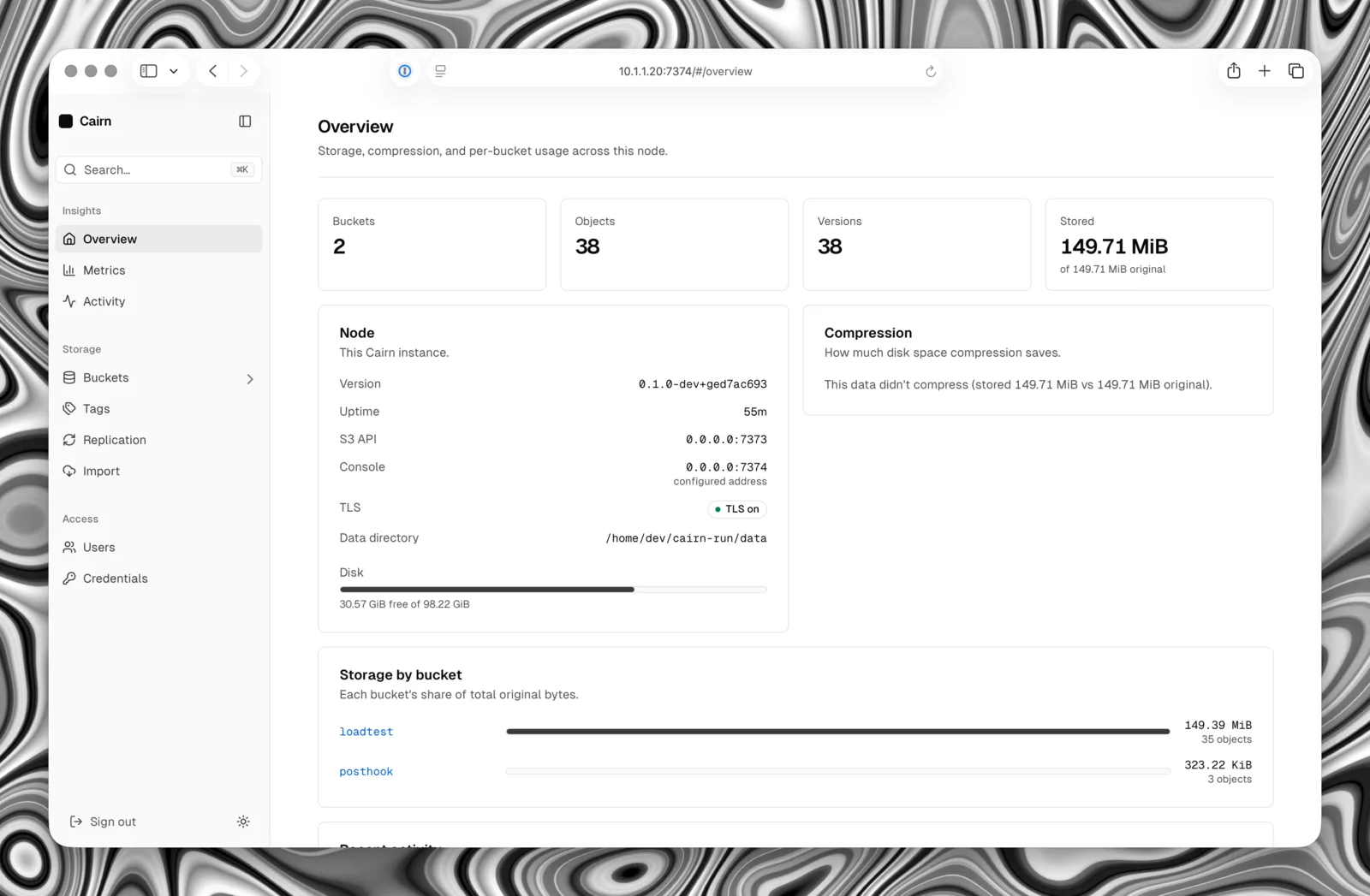
Storage, compression and per-bucket usage across the node.
 |
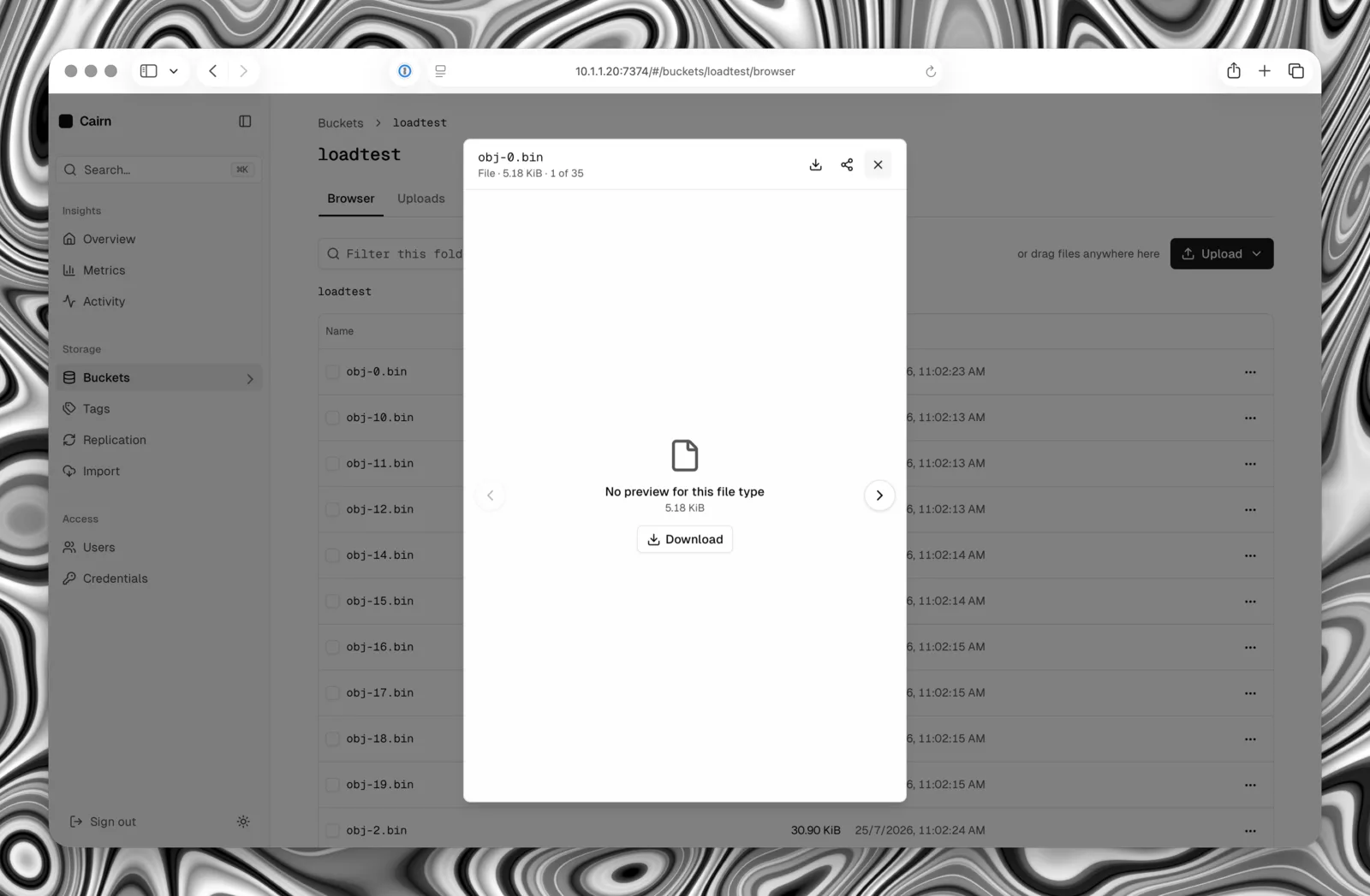 |
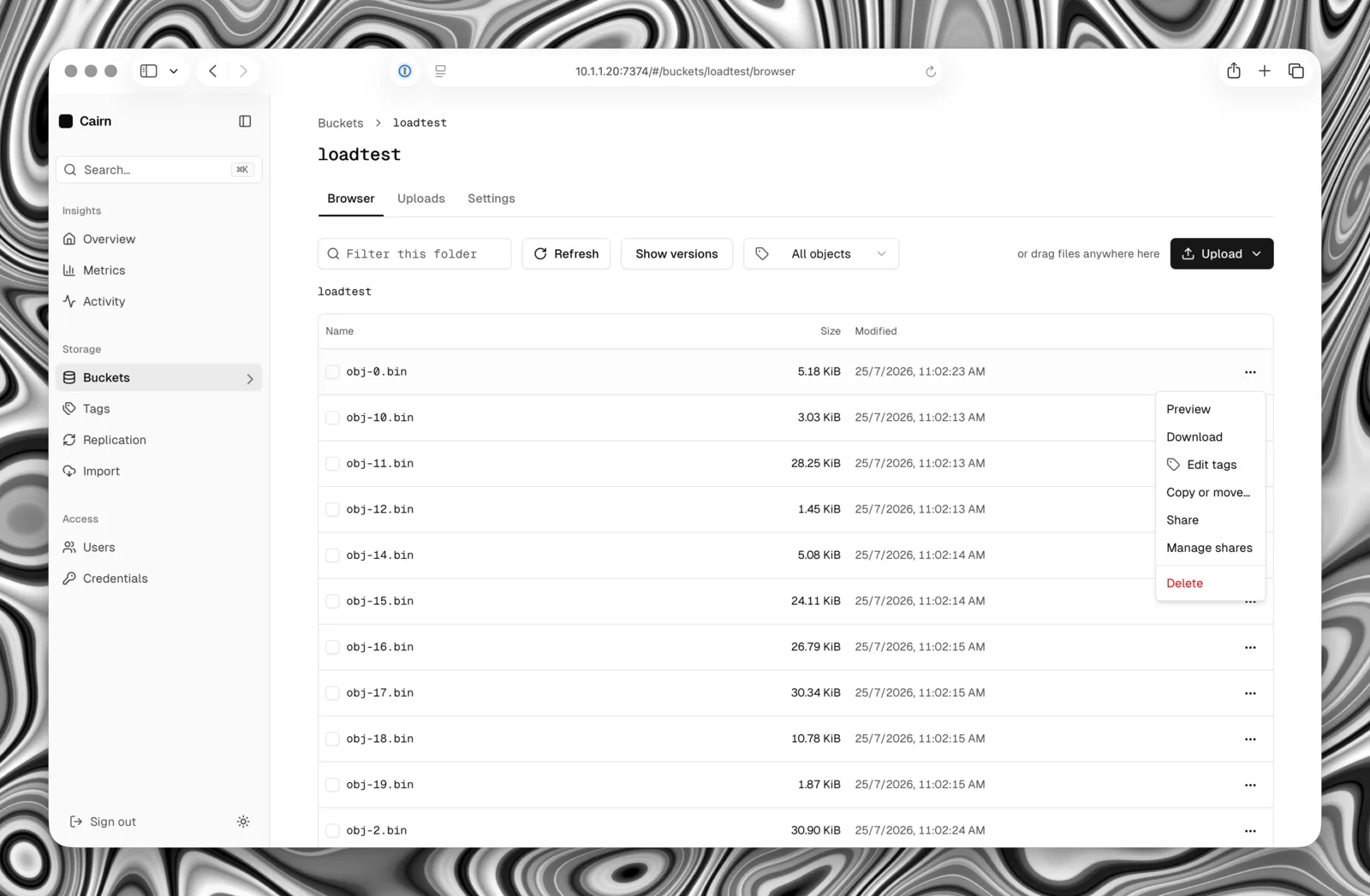
| Bucket browser — preview, download, tag, copy, share or delete any object. | In-place preview — images, video, audio, PDF, Markdown, JSON, CSV and text, without downloading. |
 |
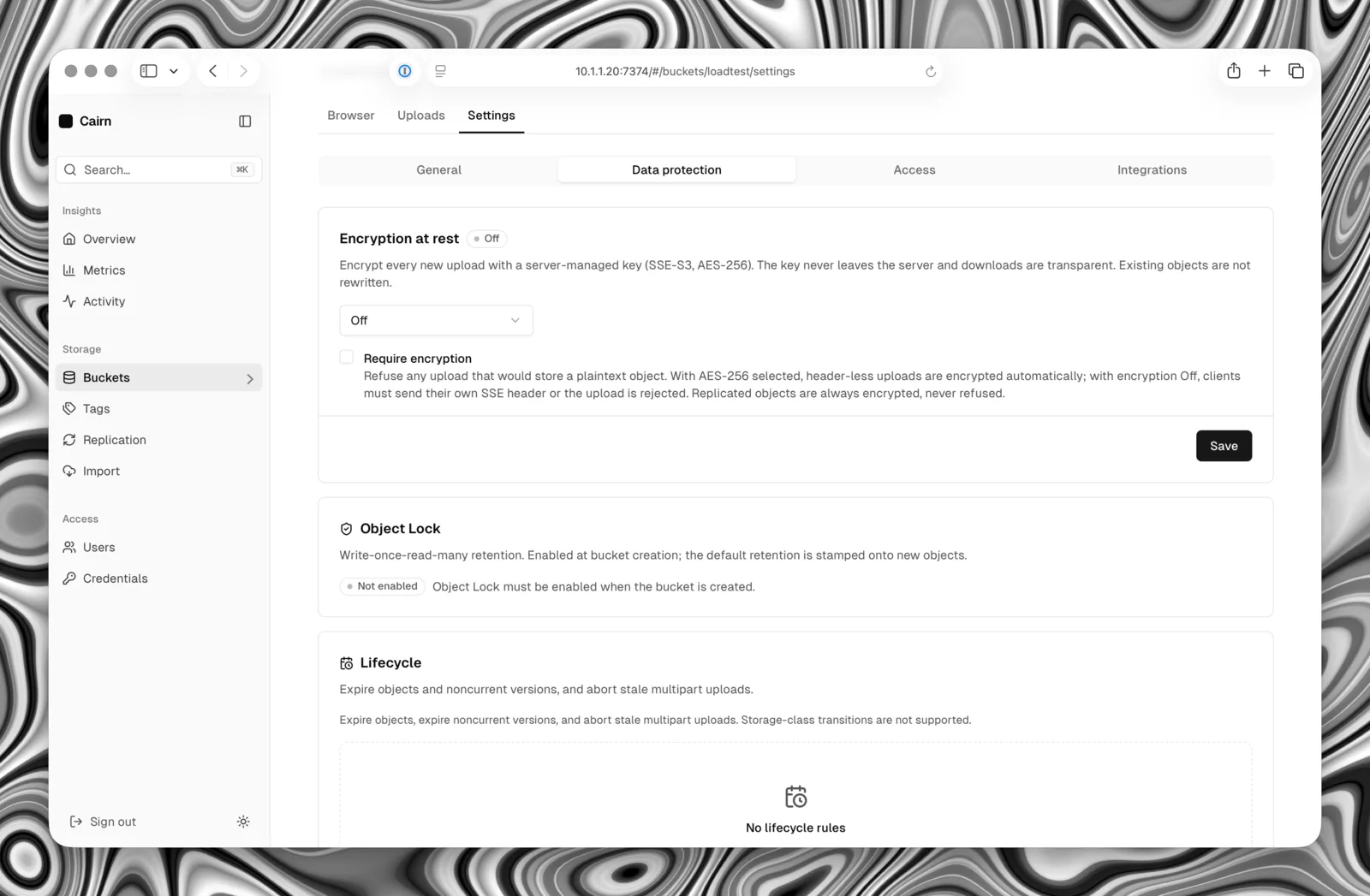 |
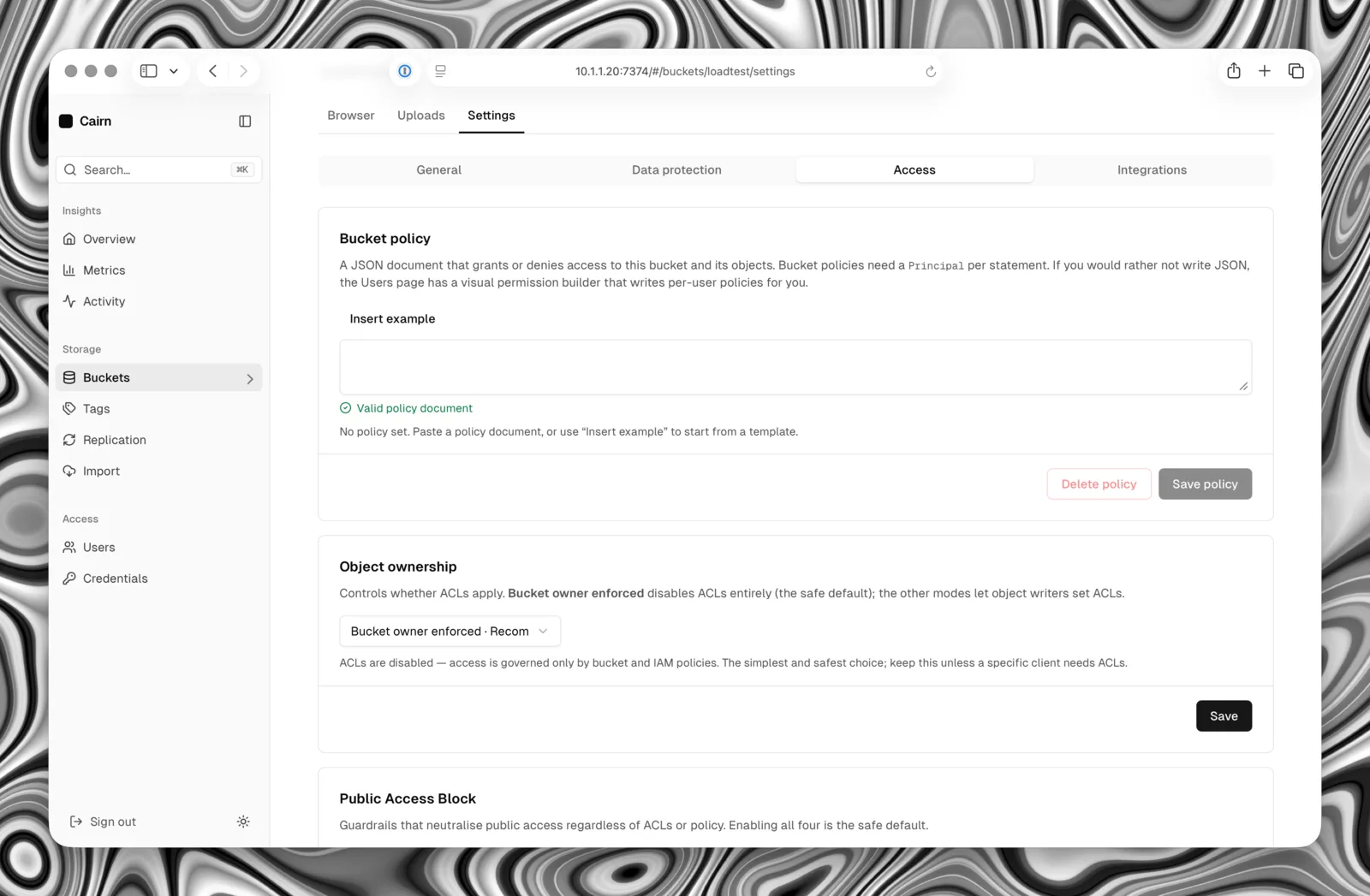
| Access — a validated bucket-policy editor, object ownership, Block Public Access. | Data protection — encryption at rest, Object Lock, lifecycle rules. |
 |
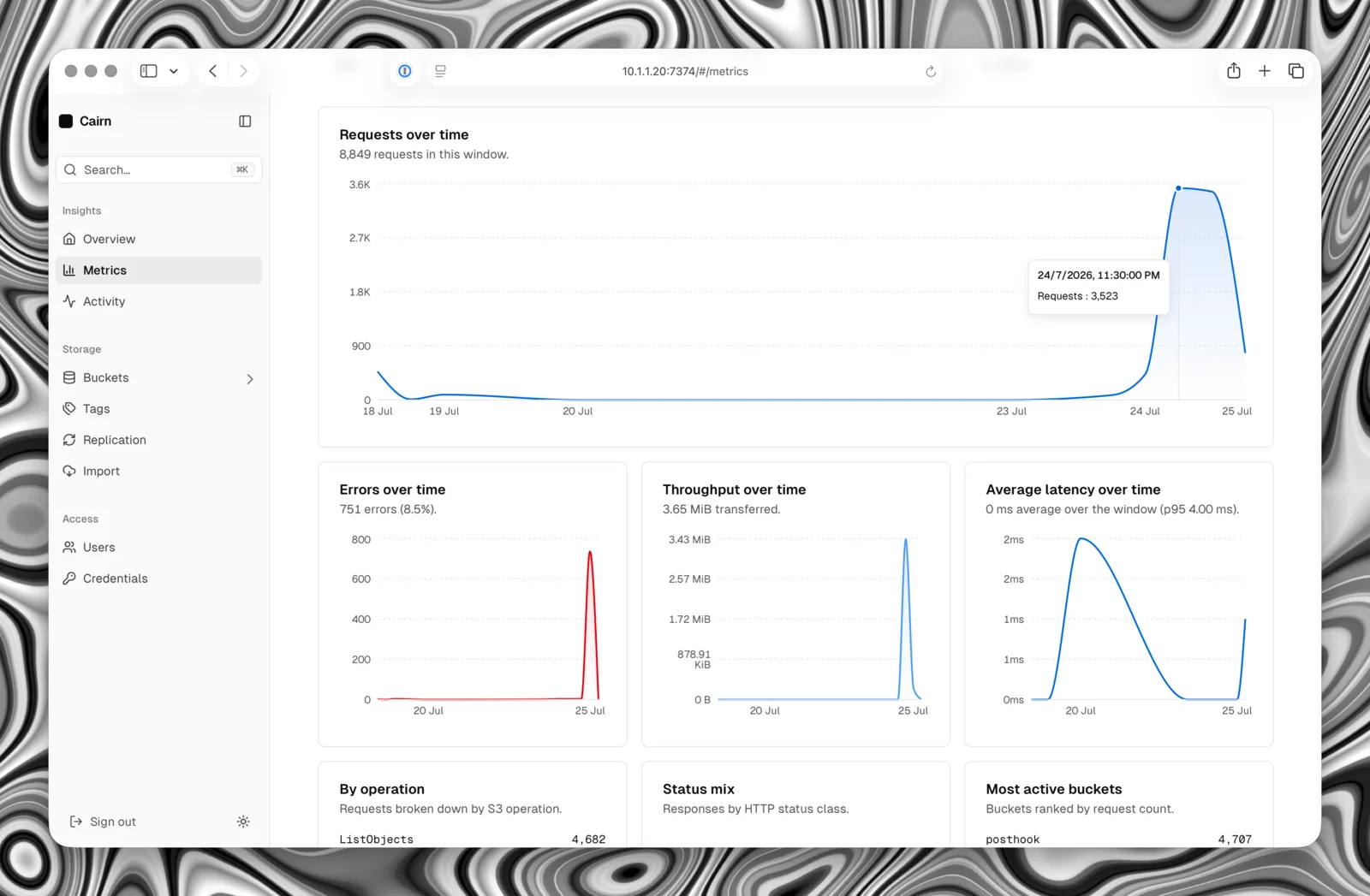 |
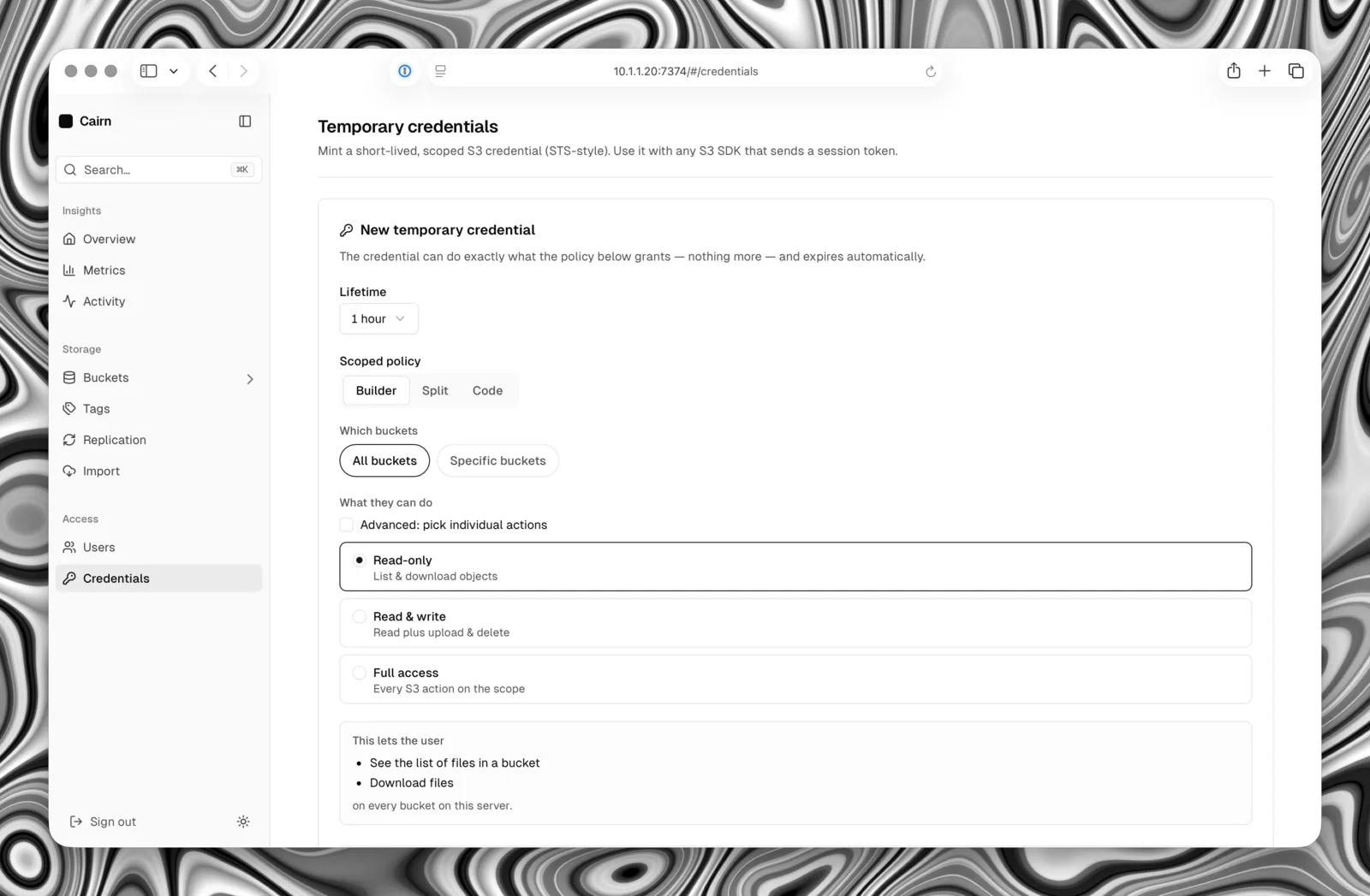
| Credentials — mint short-lived scoped keys with a policy builder that explains them. | Metrics — requests, errors, throughput and latency from Cairn's own stored series. |
More screens on the project site.
- S3 API: buckets and objects, byte-range and conditional reads, checksums (CRC32, CRC32C, CRC64NVME, SHA-1, SHA-256), multipart upload, copy, bulk delete, and v1/v2 plus version listings. Versioning, tagging, CORS, lifecycle expiration, object lock (WORM), and presigned URLs. SigV4 (header and streaming-chunked) and Bearer authentication. The aws CLI and the standard AWS SDKs work against it.
- Web console: on its own port, manage buckets and users; browse, upload, download and share objects; preview images, video, audio, PDFs, Markdown, JSON, CSV and text in place without downloading them; mint access keys scoped by a policy; view storage, compression, and replication status; jump anywhere with a command palette; and see when a newer release is available (an hourly, opt-out check).
- Access control: bucket policies, ACLs, Block Public Access, Object Ownership, and short-lived
credentials, mintable through the AWS-STS wire surface (
AssumeRole,GetSessionToken) served on the S3 port or through the management API. - Durability: writes are staged, fsynced, atomically renamed, and acknowledged after a single metadata commit. On restart Cairn reconciles and reclaims any orphaned data. Acknowledged writes survive power loss.
- Security: native TLS, AES-256-GCM encryption of secrets at rest with online master-key rotation,
and server-side object encryption: per-bucket SSE-S3, an
aws:kmsrequest surface (label-only, see Scope), optional mandatory-encryption enforcement, and transparent encryption of all objects at rest (CAIRN_ENCRYPT_AT_REST). - Storage efficiency: optional per-bucket block compression, with range reads that touch only the blocks they need.
- Operations: Prometheus metrics (with a ready-to-import dashboard for an external monitoring stack), liveness and readiness endpoints, structured logs, asynchronous bucket replication to another node or S3 endpoint, webhook event notifications, one-shot streaming import/migration of buckets and objects from another S3-compatible store (MinIO/Garage/R2/AWS/another Cairn) into this node, and a CLI for bootstrap, config validation, integrity checks, and backup and restore.
The install script sets Cairn up on a host or with Docker, and updates an existing installation when you run it again:
curl -fsSL https://raw.githubusercontent.com/Harsh-2002/Cairn/main/install.sh | sudo shIt detects Docker and offers it (or installs the binary with a systemd or OpenRC service), generates
the master key and admin credentials, can enable TLS, and stores data in a Docker named volume or
under /var/lib/cairn. The Docker setup lives in /opt/cairn so you can edit the compose file. Run
sh install.sh --help for options such as --docker, --host, --update, and --uninstall.
To set it up by hand with Docker instead:
docker build -t cairn .

docker run -d --name cairn \
  -p 7373:7373 -p 7374:7374 \
  -v cairn-data:/data \
  -e CAIRN_MASTER_KEY="$(openssl rand -hex 32)" \
cairn serve- S3 API on
:7373. Point any S3 client athttp://localhost:7373. - Web console on
:7374. Openhttp://localhost:7374in a browser. - Default login is
cairn/cairnadmin. Override it withCAIRN_ROOT_ACCESS_KEYandCAIRN_ROOT_SECRET_KEYbefore exposing a node. Liveness is at/healthz, readiness at/readyz, and Prometheus metrics at/metrics, all on the S3 port.
Smoke-test with the AWS CLI (configure it with the access key and secret above, any region):
aws --endpoint-url http://localhost:7373 s3 mb s3://demo
echo 'hello cairn' | aws --endpoint-url http://localhost:7373 s3 cp - s3://demo/hi.txt
aws --endpoint-url http://localhost:7373 s3 cp s3://demo/hi.txt -
CAIRN_MASTER_KEY is a 32-byte hex key that seals every secret at rest. Generate it once, keep it
constant for the life of your data, and store it outside the database backup. Without it, a fixed
development key is used, which is not safe for production.
To run without Docker, build the cairn binary from source and run cairn serve with the same
environment. See CONTRIBUTING.md for the toolchain.
Configuration is environment-only. Every setting is a CAIRN_* variable, validated on startup with
cairn validate-config. There is no config file and there are no flags. Common variables:
| Variable | Default | Purpose |
|---|---|---|
CAIRN_DATA_DIR |
./data |
Root of staging and per-bucket object files |
CAIRN_DB_PATH |
./data/cairn.db |
SQLite metadata file (same filesystem as the data) |
CAIRN_MASTER_KEY |
dev key | 32-byte hex key sealing secrets at rest; set it in production |
CAIRN_LISTEN_ADDR |
0.0.0.0:7373 |
S3 API listener |
CAIRN_WEB_ADDR |
0.0.0.0:7374 |
Console and management API; set off to run headless |
CAIRN_REGION |
us-east-1 |
Region label and SigV4 scope |
CAIRN_TLS_CERT_PATH / CAIRN_TLS_KEY_PATH |
unset | Enable built-in TLS when both are set |
CAIRN_MASTER_KEY_RING |
unset | Key ring for online master-key rotation |
The full reference is in docs/configuration.md. CLI subcommands:
cairn serve (default), validate-config, bootstrap, integrity [--repair], backup, and
restore.
- Two listeners. Expose the S3 port to clients, and keep the console and management port on a trusted
interface, firewalled, or disabled with
CAIRN_WEB_ADDR=off. Do not expose a plaintext interface to an untrusted network. - TLS. Terminate TLS at Cairn (set the cert and key paths;
SIGHUPreloads) or at a reverse proxy in front. - Redundancy. Put the data filesystem on redundant storage such as ZFS, RAID, or a replicated block volume. For cross-host redundancy, run a second node and enable bucket replication to it.
- Backups. Use
cairn backupandcairn restore. Seedocs/backup-restore.md.
Operator guides: docs/operations.md,
docs/deployment-kubernetes.md,
docs/upgrade-rollback.md,
docs/scaling-limits.md,
docs/disaster-recovery.md, and
docs/troubleshooting.md.
A like-for-like comparison against MinIO, both on the same 2 vCPU / 16 GB host, using MinIO's own
warp benchmark. Both run single-node, single-drive, over plaintext
HTTP; each figure is the median of three runs.
Throughput (higher is better; obj/s for small objects, MiB/s for large):
| Operation | Object size | Cairn | MinIO | Ratio |
|---|---|---|---|---|
| PUT | 4 KiB | 1696 obj/s | 1308 obj/s | Cairn 1.30× |
| PUT | 8 MiB | 115 MiB/s | 128 MiB/s | MinIO 1.12× |
| GET | 4 KiB | 3431 obj/s | 1815 obj/s | Cairn 1.89× |
| GET | 8 MiB | 1463 MiB/s | 801 MiB/s | Cairn 1.83× |
| STAT | 4 KiB | 3494 obj/s | 1824 obj/s | Cairn 1.92× |
| DELETE | 4 KiB | 7442 obj/s | 5236 obj/s | Cairn 1.42× |
| LIST | 4 KiB | 21183 obj/s | 10288 obj/s | Cairn 2.06× |
| MIXED | 1 MiB | 285 MiB/s | 271 MiB/s | Cairn 1.05× |
Resource use while serving the same workload (lower is better):
| Mean CPU | Peak memory | |
|---|---|---|
| Cairn | 76% | 106 MB |
| MinIO | 88% | 1072 MB |
Absolute numbers depend on the host and vary between runs; the ratio is what to read. Reproduce it
with the harness CI runs on every push (bench-compare):
BIN=target/release/cairn bash conformance/bench_compare.shCairn is single-node by design: one process, one data filesystem, one metadata database. Cross-host
redundancy comes from asynchronous bucket replication, which is eventually consistent with observable
lag, rather than from clustering. Drive redundancy is left to the storage underneath. Server-side encryption is supported — SSE-S3
(per-bucket AES-256 default encryption, optionally mandatory), an aws:kms request surface for SDK
compatibility (the key id is a validated label over the same node master key, not independent key
material, so it is not cryptographic tenant isolation), and optional transparent encryption of every
object at rest (CAIRN_ENCRYPT_AT_REST). A dedicated external KMS with distinct per-key material is
not implemented. The target is homelab and small-to-mid production workloads that want the S3 API and
a console without running a distributed system.
Planned work, tracked against the architecture in docs/delivery.md (Phase 15).
These are additive and do not change the S3 or management API.
- Integration with an external KMS (distinct per-key material and tenant isolation); the current
aws:kmssurface is a label over the node master key, and transparent encryption of all objects at rest already ships (CAIRN_ENCRYPT_AT_REST). - Lifecycle transition to a remote cold tier, with a restore-from-cold workflow.
- Zero-copy reads with kernel TLS, building on the existing sendfile fast path.
- Signed release artifacts (cosign) and SBOM attestation.
The engineering specification and operator guides are in docs/; start at
docs/CLAUDE.md for the index. docs/s3-api-matrix.md
lists which S3 operations are supported, partial, or out of scope.
Apache-2.0 (LICENSE). The license is permanent; there is no enterprise edition or
open-core split. Governance and maintenance are described in GOVERNANCE.md. See
SECURITY.md for the security policy, CODE_OF_CONDUCT.md
for community expectations, and CONTRIBUTING.md for the developer workflow.