


I turn ambiguous, high-friction operations into local-first software with inspectable artifacts, measurable outcomes, and explicit human approval.
Applied AI | Forward-deployed workflows | Evidence-gated automation
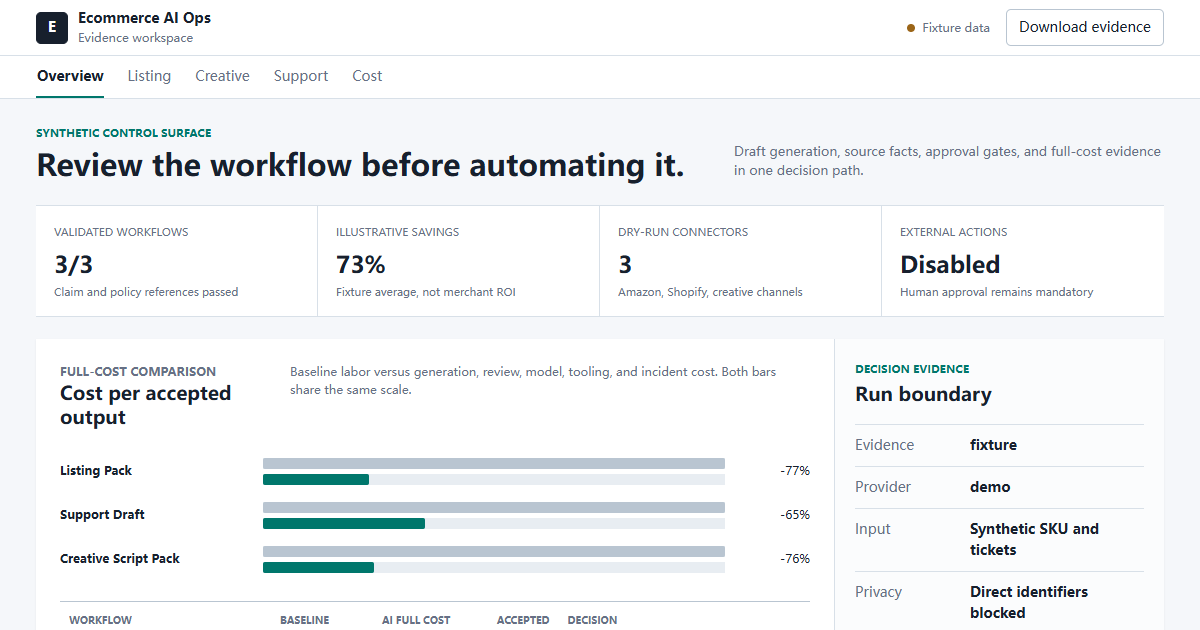
A privacy-gated operating lab for testing whether AI actually reduces ecommerce cost. It covers Amazon-style listing drafts, short-form creative briefs, support-response drafting, full-cost measurement, and dry-run platform request packages.
- Offline deterministic demo plus opt-in OpenAI Responses integration
- Source-fact references and prohibited-claim validation
- Amazon, Shopify, TikTok Ads, and YouTube Shopping dry-run connectors
- Human review before publishing, messaging, refunds, or account changes
- Measured-experiment contract that includes review, rework, and incident cost
Live evidence dashboard | Repository | Experiment protocol | Safety model
| System | What it demonstrates | Review surface |
|---|---|---|
| stock-analysis-plus | Evidence-grounded research workflows, market-data adapters, explicit gaps, and reproducible validation bundles. | Live demo |
| deckgen-local | Contract-first generation from source packages to reviewable HTML and optional PPTX artifacts. | Live demo |
| ai-job-radar | Source-health-aware job discovery, structured matching, and human-reviewed application decisions. | Live demo |
| consulting-crm-lite | Anonymized consulting operations, delivery packets, approval gates, and public-safe case-study export. | Live demo |
| research-to-deck | Traceable research synthesis with source grounding, QC reports, and presentation-ready outputs. | Live demo |
| Stage | Output |
|---|---|
| Frame | A concrete operating problem, decision owner, baseline, and failure boundary |
| Build | The smallest workflow that can produce a useful, inspectable artifact |
| Gate | Privacy checks, source validation, dry-run adapters, and human approval |
| Measure | Accepted-output cost, quality guardrails, rework, incidents, and next decision |
- Local-first by default. Credentials, source data, browser state, and runtime outputs stay outside public repositories.
- Evidence before confidence. Missing, stale, or partial inputs remain visible instead of being converted into false certainty.
- Artifacts over demos. JSON, Markdown, HTML, SQLite, and PPTX outputs are designed to be audited and handed off.
- Automation stops at consequence. Publishing, account mutation, financial actions, and customer-impacting changes require approval.
- Public work is extracted, not mirrored. Each public repository is a minimal, synthetic, independently reviewed boundary.
Python | JavaScript / TypeScript | Node.js | SQLite | Deno |
GitHub Actions | OpenAI Responses API | Chrome DevTools Protocol
I am focused on Applied AI Product, Forward Deployed Product, and AI Solutions work where the hard part is not producing a model response, but integrating the workflow into real operations and proving that it is safer, faster, or cheaper.
The most useful conversations start with a real process, its current cost, and the decision that better evidence would unlock.