


Give AI agents the power to act across real software. Keep the final authority.
Maqam is an open-source AI agent governance layer for TypeScript. Put a function, CLI worker, coding agent, crawler, browser connector, MCP-backed operation, or internal service behind one registered gateway. Maqam checks policy before dispatch, binds human approval to the exact input that will run, allows that approved call once, rejects altered input and replay, and leaves a verifiable receipt.
Cockroach Crawler gives the stack bounded eyes on public sources. Qarinah gives it compact, evidence-linked memory. Maqam governs the hands that act. Only operations routed through a registered Maqam adapter are governed.
It combines a local runtime, policy engine, evidence ledger, skill registry, tool gateway, exact human approvals, generic worker adapters, coding-agent CLI adapters, governed browser contracts, and research-source routing in one MIT-licensed package.
The crawler is not the product center; it is one built-in connector. Maqam governs workers that enter through ToolGateway, including function agents, explicitly bound object agents, Codex CLI, Claude Code, generic command-line workers, browser and research adapters, internal services, and write actions that need human approval. Calls that bypass a registered adapter are outside Maqam's control.
Current stable release: maqam@0.3.3. It carries the full 0.3 governance surface with an image-free npm README and current package metadata. Verify the immutable artifact with npm view maqam@0.3.3 version gitHead dist.integrity.
Website · Full documentation · Why Maqam · ProductLoop OS · Community
- Put registered functions, object agents, Codex CLI, Claude Code, fixed command-line workers, browser actions, crawlers, research adapters, and internal services behind one inspectable control path.
- Add a practical application-side control plane without replacing the model, orchestrator, agent SDK, or existing tool implementation.
- Evaluate policy before a registered operation runs, including its declared effect, origin, time, output, call, and evidence boundaries.
- Bind human approval to the exact run, tool, and canonical input instead of approving a vague future action.
- Consume exact approval once by default, rejecting changed input and replay.
- Turn successful dispatches, denials, approval use, and evidence links into reviewable execution records.
- Combine governed action with bounded browser and research adapters without silently widening their network or credential authority.
- Route hosted-anonymous Exa web search, public YouTube metadata and available captions, RSS/Atom feeds, and host-supplied crawlers through explicit governed source adapters.
Maqam does not intercept direct operating-system calls or make an unsafe tool safe. An operation is governed only when the host deliberately routes it through a registered Maqam boundary.
Install Maqam when you need one compact governance boundary around registered tool calls, exact approvals, guarded browser actions, coding-agent workers, traces, evidence, and governed research sources. ProductLoop OS is the optional modular toolbox for teams that also need separate workflow, policy, approval, provenance, skill, connector, evaluation, and research packages.
Neither product replaces model providers, durable orchestration, identity, databases, browser engines, or operating-system sandboxes. Only operations routed through a registered boundary are governed. See the Maqam quickstart or the separate ProductLoop package atlas.
The current control-plane demo runs Cockroach Crawler source collection, Qarinah context compilation, Maqam policy, altered-input rejection, one exact approved write, replay rejection, tests, and a causal receipt as one continuous engineering workflow. Read the 60-second workflow and run it locally.
The proof media in this section was produced for the historical 0.2.4 release and remains labeled with that artifact identity. It demonstrates durable product behavior, but it is not relabeled as 0.3.0 release evidence.
Watch the 60-second exact-approval proof, then reproduce the same approval, mismatch, execution, replay, and evidence sequence locally with npx -y maqam@0.3.3 demo approval --json.
The exact-approval video is rendered from JSON emitted by the real maqam demo approval --json command. Its approval id, hashes, execution counts, evidence ids, and rejection codes come from the released implementation rather than a staged interface.
| Demonstration | Video | Captions |
|---|---|---|
| Exact approval: altered input blocked, exact input executed once, replay blocked | MP4 | VTT · SRT |
| ProductLoop OS: Maqam plus eight explicit package namespaces | MP4 | VTT · SRT |
| Governed crawler research: bounded collection, citations, and evidence | MP4 | VTT · SRT |
| Start with | Use it for |
|---|---|
| Complete feature inventory | Every public runtime, policy, approval, evidence, adapter, browser, research, crawler, server, release, verification, and security capability, plus explicit non-goals |
| Five-minute quickstart and full usage guide | Local proof, installation, APIs, cleanup, and deployment boundaries |
| Why Maqam and detailed comparison | Product fit, alternatives, differences, limitations, sources, and licenses |
| ProductLoop package atlas | Package-by-package roles, versions, examples, and Maqam relationship |
| Integration guide and Google ADK / Microsoft Agent 365 boundary | Host adapters, prerequisites, copy-paste templates, and bypass warnings |
| Governed Sources | Ordered source adapters, ToolGateway routing, normalized documents, source doctor, RSS/Atom, fallback, and security boundaries |
| Anonymous-public source pack | No-developer-key Exa MCP search and separately installed yt-dlp YouTube metadata/captions, with credential classes, limits, terms, privacy, and safe registration |
| Governed browser adapters | Structural observe/preview/apply/submit contracts, exact origins and approvals, opaque value references, Page Agent composition, and driver trust boundaries |
| MGES benchmark guide and raw methodology | Reproducible local-call and conformance evidence with claim limits |
| Security guide and security policy | Threat boundaries, reporting, crawler safety, and required host controls |
| Coding-agent guide | Codex, Claude Code, generic CLI workers, approvals, and outcome checks |
| Launch kit | Benefit-first descriptions, platform copy, media assignments, launch order, and claim checks |
| Cockroach Crawler docs and Maqam integration guide | Dedicated bounded crawling plus a copy-pasteable registered ToolGateway composition |
| Public roadmap and source roadmap | Shipped baseline, next work, exit criteria, and explicit non-goals |
| Community hub, contributing, and governance | Questions, examples, issues, forks, reviewed pull requests, and maintenance policy |
| Historical 0.2.4 release note, historical source release record, Release checklist, and Provenance and license notes | Exact package map, verification evidence, MGES caveats, provenance, licenses, and approval history |
| 0.3.0 release record and 0.3 migration guide | New source-routing surface, breaking CLI change, required verification, exact-artifact approval, and historical-evidence rules |
Articles: Your Agent Approval May Not Authorize the Input That Actually Executes · Benchmarking an Agent-Governance Boundary Without Fooling Yourself
Open the Maqam system map · Open the governed CLI worker flow
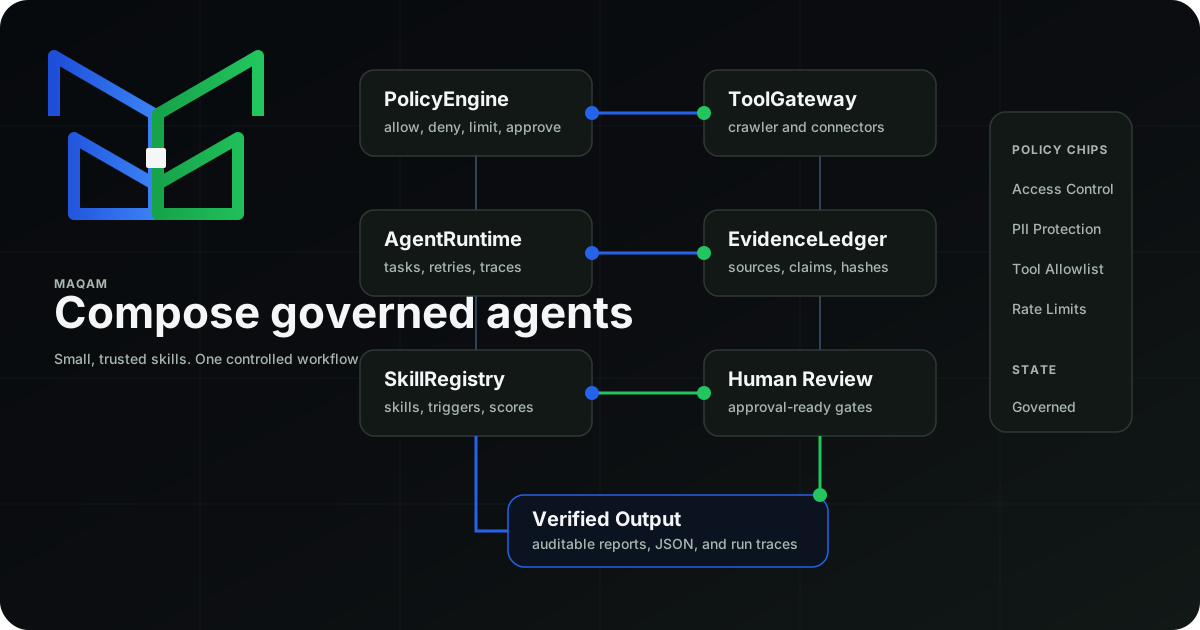
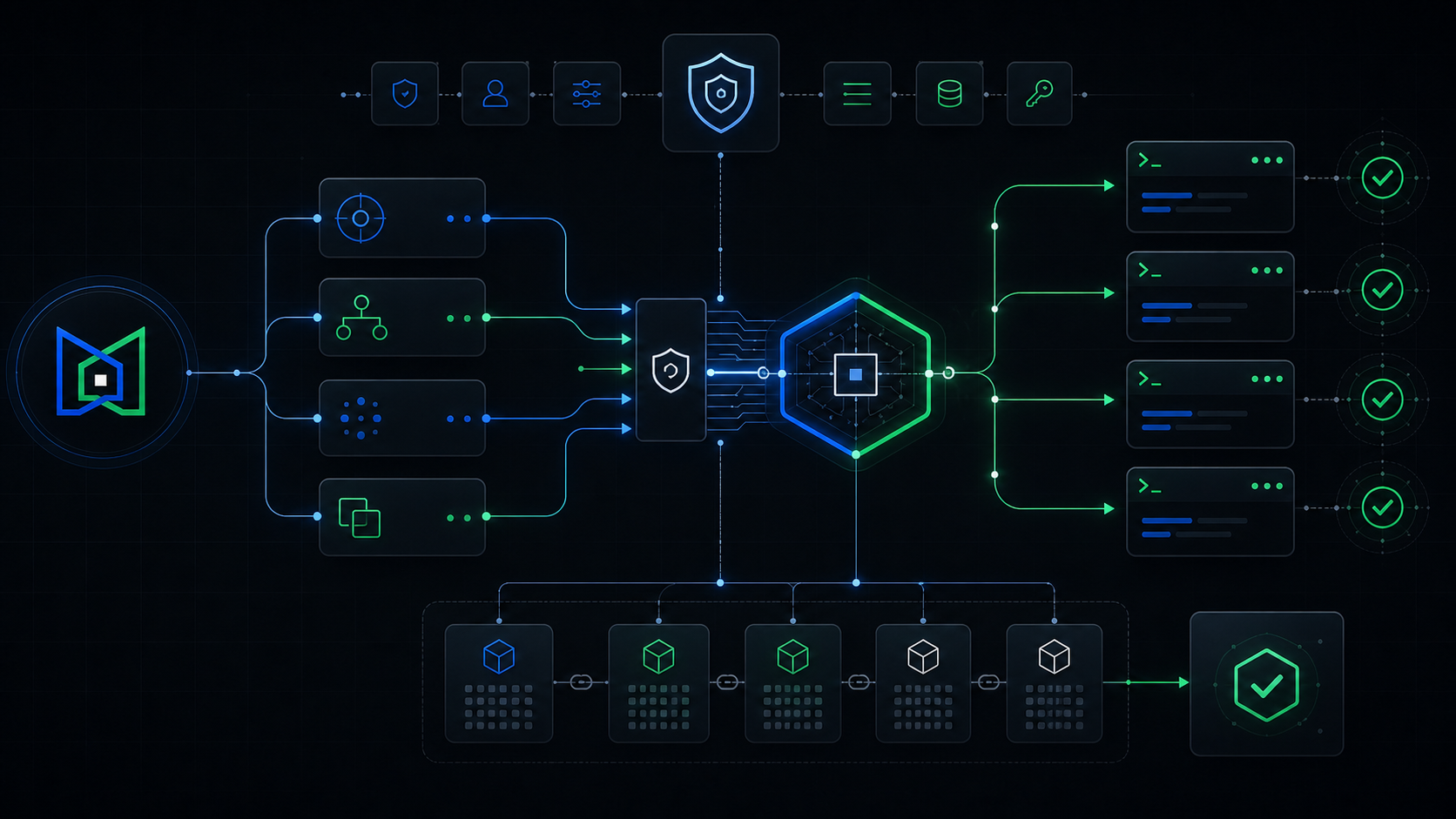
Maqam controls agents by putting every worker behind the same gateway:
flowchart LR
  Goal["Goal"] --> Policy["PolicyEngine"]
  Policy --> Runtime["AgentRuntime"]
  Runtime --> Gateway["ToolGateway"]
  Gateway --> FunctionAgent["Function agent"]
  Gateway --> ObjectAgent["run / invoke / call agent"]
  Gateway --> Codex["Codex CLI adapter"]
  Gateway --> Claude["Claude Code adapter"]
  Gateway --> CliWorker["Generic CLI worker"]
  Gateway --> Connector["Crawler or SaaS connector"]
  FunctionAgent --> Evidence["EvidenceLedger"]
  ObjectAgent --> Evidence
  Codex --> Evidence
  Claude --> Evidence
  CliWorker --> Evidence
  Connector --> Evidence
  Evidence --> Review["Trace, claims, approval path"]
That means Maqam is not limited to crawling. If an agent can be called as a function, object method, HTTP/SDK connector, or fixed command-line worker, Maqam can route it through policy, runtime and call ceilings, trace capture, evidence, and configured human approval gates. Only registered adapters are governed; provider-reported token ceilings may be post-run, and a container or virtual machine is still needed for a hard operating-system boundary.
Maqam does not try to own the entire agent stack. Its focused job is to connect four controls in one small TypeScript package:
- decide whether a registered tool call is allowed;
- bind required approval to the exact run, tool, and canonical input hash;
- consume that approval once by default and pass the same detached input to the governed handler; and
- provide scoped APIs for handlers and workflows to explicitly connect claims to source evidence from the same run.
Use Maqam when that enforcement path matters more than adopting a larger platform. It can wrap an existing function, CLI worker, coding agent, crawler, browser connector, or internal service. Calls that bypass the registered adapter are outside Maqam's control, and evidence links show provenance rather than proving that a claim is true.
| If your primary need is | Stronger starting point | Where Maqam fits |
|---|---|---|
| Broad identity, trust, compliance, fleet, and multi-language governance | Microsoft Agent Governance Toolkit | A smaller local TypeScript boundary with explicit exact-call approval and claim/evidence semantics. |
| A full TypeScript agent loop, handoffs, sessions, models, and tracing | OpenAI Agents SDK | Govern selected external actions; do not replace the SDK's agent loop or first-class human approval flow. |
| Durable, branching, restart-safe orchestration | LangGraph | Call Maqam-governed tools from graph nodes; Maqam's current state is in-process. |
| Contextual traffic, model-facing, or prompt-injection guardrails | Invariant or NeMo Guardrails | Add action policy, exact gateway approvals, and source-linked evidence. |
| Mature general policy-as-code | Open Policy Agent | Use OPA as a decision engine while Maqam supplies the agent-specific enforcement and approval lifecycle. |
| Browser automation or crawler operations | Crawl4AI, Firecrawl, or Crawlee | Put a separately installed connector behind Maqam; its built-in crawler remains deliberately smaller and HTTP-only. |
See the detailed, dated comparison, including limitations and source/license notes, before choosing a stack.
AgentRuntime: sequential workflow execution with opt-in retries, cancellation-aware deadlines, trace events, unique run ids, task outputs, and policy preflight.PolicyEngine: fail-closed goal and tool-call decisions for allowed tools, origins, effects, clamped tenant limits, and approval gates.EvidenceLedger: private, transactional provenance records with computed source hashes, same-run claim links, confidence, and unsupported-claim checks.ToolGateway: a policy-required path with call ceilings, redacted traces, effective origin scope, non-downgradable handler effects and risk, fail-closed policy-decision validation, and exact one-time approval binding.ToolGateway.registerGuardedTool: gives an adapter a private verifier for the exact active input, handler context, registration, decision, and consumed approval receipt without exposing a reusable capability.registerGovernedBrowserTools: registers structural observe, preview, apply, and submit operations around a host-owned driver; plans must be issued by preview for the same run, writes require exact phase approval, each driver call receives only the origins named by that request, and raw values, selectors, scripts, downloads, file/clipboard/permission actions, and dialogs are excluded. Apply and submit drivers must block the prohibited effects before dispatch and return the explicit all-false effects record described in the browser adapter guide.createAgentTool: wraps any function agent or explicitly bound object agent so Maqam can control it through policy, trace, approval, and atomic evidence/claim capture.createCliAgentTool: wraps fixed command-line workers with cwd roots, environment allowlists, cancellation, timeout, approximate token limits, JSONL parsing, and no shell execution by default.createCodexAgentTool: runs Codex non-interactively with a read-only default, ephemeral sessions, JSONL activity, and normalized token usage.createClaudeCodeAgentTool: runs Claude Code with plan mode by default, no tools by default, max turns, spend limits, stream events, and normalized usage.ApprovalQueue: in-memory, serializable human approval records for release gates, external writes, and high-risk actions.createReleaseGateReport: release-evidence and exact publish-approval reporting; it reports readiness but does not execute publishing.SkillRegistry: private, snapshot-based skill metadata registration and selection.ResearchSourceRegistry: deterministic source-backend selection with explicit preferences, fatal-error stop rules, governedToolCallerrouting, normalized documents, and bounded attempt records.createWebCrawlerSourceAdapter: connects a host-suppliedcrawl()orcreateCrawlerTool()function to the governed source registry under one fixedresearch.web-crawler.directtool identity; the factory has no separate fetch, login, or credential fallback.parseRssAtomand RSS/Atom adapter factories: offline bounded feed parsing around a host-supplied reader, with no implicit network or login behavior.createResearchWorkflow: crawler-backed source collection, bounded result validation, synthesis, and quality checks.maqam: local web console for running governed research workflows.maqam-crawl: bounded crawler CLI with per-origin delay, robots.txt enforcement, redirect validation, DNS pinning, and public-network-only defaults.
Agent systems fail in production when tools run outside policy, outputs cannot be traced to sources, and risky actions happen without approval. Maqam makes those control points explicit:
- Every workflow starts with policy preflight.
- Tenant budgets and origin scope cannot be raised by a workflow.
- Every connected tool call goes through
ToolGatewayand is counted per run. - Every source-backed claim can be recorded in
EvidenceLedger. - Tasks and tools receive run/task/tool-scoped evidence facades; they cannot choose trusted attribution fields or access the raw ledger.
- Every run returns trace data for inspection; Maqam does not yet provide durable replay or restart-safe checkpoints.
- Approval-required actions fail closed with
ApprovalRequiredError. - Approval records are bound to the exact run, tool, and input hash, then consumed once by default.
- The crawler blocks private and special-purpose destinations by default and validates every redirect hop.
Maqam supports the maintained Node.js 22 LTS, 24 LTS, and 26 Current release lines.
npm view maqam@0.3.3 version dist.integrity gitHead
npm install -g maqam@0.3.3
Run the exact-approval proof without a model key or hosted account:
maqam demo approval
maqam demo approval --json
maqam --version
The flow requests approval, rejects altered input with APPROVAL_SCOPE_MISMATCH while executions remain zero, executes the exact input once, rejects replay with APPROVAL_INVALID, and links ev_1 to claim_1.
Run the local console:
maqamThen open http://127.0.0.1:8787.
Use inside a project:
npm install maqam@0.3.3maqam-crawl https://example.com --max-pages 50 --jsonl --output crawl.jsonlLegacy aliases ajnas-crawl and ajnas-agent-crawler are kept for compatibility.
Options:
--max-pages <n>: maximum pages to return. Default:50--max-requests <n>: maximum network requests--max-depth <n>: maximum link depth. Default:20--max-bytes <n>: maximum bytes per response. Default:3145728--max-duration <ms>: maximum total crawl duration. Default:600000--max-retries <n>: retries per request. Default:2--concurrency <n>: concurrent workers. Default:4--delay <ms>: minimum delay per origin. Default:250--timeout <ms>: request timeout. Default:15000--sitemaps: discover URLs from robots.txt sitemaps and/sitemap.xml--feeds: discover and parse linked RSS/Atom feeds--max-feed-links <n>/--max-feed-items <n>: bound feed discovery and parsing--allowed-origin <url>: permit one additional origin; repeat for every origin--detailed: emit{ pages, failures, stats }--stats: write crawl statistics to stderr--fail-on-error: exit with status 2 when non-fatal failures are present--jsonl: output JSON Lines instead of a JSON array--output <file>: write output to a file--user-agent <ua>: custom user agent
The CLI accepts public HTTP(S) targets only. It validates every DNS result and redirect, rejects embedded credentials and special-purpose address ranges, obeys robots.txt by default, and caps each response. The old unbounded --all-origins switch is intentionally rejected; name every additional public origin with a repeatable --allowed-origin flag. --detailed and --jsonl cannot be combined.
Use ResearchSourceRegistry when one research channel has multiple possible backends but every selected operation must remain visible at ToolGateway:
const sources = new ResearchSourceRegistry({
  adapters: [rssSource, internalSearch],
  toolCaller: defineResearchToolCaller({
    call: gateway.call.bind(gateway)
  })
});

const result = await sources.route({
  channel: "research",
  input: { query: "exact approvals" }
}, { runId: "research_1" });
Register every adapter handler at its declared toolName first. route() fails closed without a bound caller. routeUngoverned() is an explicit direct bypass and does not apply policy, approvals, call ceilings, or trace capture. Read the complete guide before connecting credentials or remote providers.
The anonymous-public source-pack guide documents the opt-in no-developer-key Exa web-search and yt-dlp-backed public YouTube metadata/caption factories. "No developer key" does not mean offline, private, unlimited, authenticated, or permitted for every use. Verify the exact installed artifact before relying on either factory in a deployment.
The local console enables hosted anonymous web search directly. YouTube process execution is fail-closed until the server operator supplies a reviewed absolute executable path with maqam --yt-dlp-command /absolute/path/to/yt-dlp or MAQAM_YT_DLP_COMMAND; Maqam never imports browser cookies or downloads media through that route.
import {
  AgentRuntime,
  EvidenceLedger,
  PolicyEngine,
  ToolGateway,
  createAgentTool,
  createCliAgentTool,
  createCrawlerTool,
  createResearchWorkflow
} from "maqam";

const evidenceLedger = new EvidenceLedger();
const policyEngine = new PolicyEngine({
  allowedTools: ["crawler", "summarizer"],
  allowedOrigins: ["https://github.com", "https://www.npmjs.com"]
});

const gateway = new ToolGateway({ policyEngine, evidenceLedger });
gateway.registerTool("crawler", createCrawlerTool());
gateway.registerTool("summarizer", createAgentTool(async (input) => ({
  summary: `Reviewed ${input.topic}`
}), { name: "summarizer" }));
gateway.registerTool("localWorker", createCliAgentTool({
  name: "localWorker",
  command: process.execPath,
  args: ["--version"],
  stdin: "none",
  timeoutMs: 5000,
  maxInputTokens: 20,
  maxOutputBytes: 2048
}));

const runtime = new AgentRuntime({ policyEngine, evidenceLedger, toolGateway: gateway });
const result = await runtime.runWorkflow(
  createResearchWorkflow({
    seeds: ["https://github.com/apify/crawlee"],
    maxPages: 5
  }),
  {
    objective: "Research permissive OSS agent framework projects",
    allowedTools: ["crawler", "summarizer"],
    allowedOrigins: ["https://github.com"]
  }
);

console.log(result.outputs.synthesize_report.candidates);import {
PolicyEngine,
ToolGateway,
createClaudeCodeAgentTool,
createCodexAgentTool
} from "maqam";
const policyEngine = new PolicyEngine({
allowedTools: ["codex", "claude"],
approvalRequiredEffects: ["write"]
});
const gateway = new ToolGateway({ policyEngine });
gateway.registerTool("codex", createCodexAgentTool({
cwd: process.cwd(),
sandbox: "read-only",
timeoutMs: 120_000,
maxTotalTokens: 50_000
}));
gateway.registerTool("claude", createClaudeCodeAgentTool({
cwd: process.cwd(),
permissionMode: "plan",
tools: [],
maxTurns: 2,
maxBudgetUsd: 0.25
}));Both adapters isolate inherited environment variables, pass prompts over stdin, reject dangerous modes unless explicitly unlocked, normalize provider events, and support explicit outcome checks. Codex token ceilings are observed after the run because its CLI does not expose a hard token-budget flag; Claude Code can additionally enforce max turns and a spend ceiling. See docs/external-agents.md for complete setup, write-mode approvals, verification, limits, and security boundaries.
import { crawl } from "maqam";

const pages = await crawl({
  seeds: ["https://example.com"],
  maxPages: 25,
  concurrency: 4,
  includeSitemaps: true,
  onPage(page) {
    console.log(page.url, page.title);
  }
});

console.log(pages[0].markdown);
Private, loopback, link-local, reserved, and other special-purpose destinations are blocked by default. Every redirect is re-authorized and each connection is pinned to a validated DNS result. allowPrivateNetworks: true is a trusted local opt-in for supported private ranges; it does not allow link-local metadata endpoints or other unsafe ranges.
For failures and budget statistics, use crawlDetailed:
import { crawlDetailed } from "maqam";

const result = await crawlDetailed({
  seeds: ["https://example.com"],
  allowedOrigins: ["https://example.com"],
  maxPages: 10,
  maxRequests: 80,
  maxDepth: 5
});

console.log(result.pages, result.failures, result.stats);npm run maqamThe console runs a governed research workflow through:
PolicyEngine: allows or denies goals and tool calls.ToolGateway: routes all external work through policy checks.EvidenceLedger: records source-backed evidence and claim support.AgentRuntime: executes workflow tasks with traces and retries.createResearchWorkflow: composes crawler collection, synthesis, and quality checks.
Brand assets live in app/assets/, including maqam-logo.svg and maqam-brand-board.png.
Applications can import the typed server API from maqam/server:
import { startMaqamServer } from "maqam/server";

startMaqamServer({
  host: "127.0.0.1",
  allowedOrigins: ["https://example.com"]
});
The console accepts crawl authority only from trusted startup options. Request bodies cannot enable private networks or add origins. startMaqamServer() accepts MAQAM_API_TOKEN or apiToken; a raw server returned by createMaqamServer() requires options.apiToken. Both paths also require an explicit Host allowlist before binding beyond loopback. Calling listen(port) without a host, passing ambiguous transport options, or supplying an existing handle/file descriptor is rejected without those protections. Browser clients on another origin must be explicitly listed with repeatable --allowed-ui-origin https://console.example flags or allowedUiOrigins; CORS responses echo only the exact allowed origin and never use *.
- Respect
robots.txtby default. - Use a clear user agent.
- Rate-limit per origin.
- Validate DNS results and each redirect before connecting.
- Keep private-network crawling disabled unless a trusted local deployment explicitly needs it.
- Avoid bypassing access controls, paywalls, anti-bot systems, or private content.
- No required model provider dependency.
- No required external hosted service.
- Produce JSON/JSONL output that agents can consume directly.
Maqam is not a stealth scraper and does not include bypass tooling. It will not help evade login walls, paywalls, anti-bot protections, CAPTCHA, robots.txt, or authorization boundaries.
npm install
npm test
npm run test:consumer-types
npm run demo:approval
npm run benchmark:mges:conformance
npm run benchmark:mges:performance
npm audit --omit=dev
npm pack --dry-run
The project-defined Maqam Governance Evaluation Suite (MGES) v1.1.0 keeps performance and conformance separate. The previous public 0.3.0 evidence records a 140.816 microseconds/call governed median, 138.983-142.820 95% bootstrap interval, 5.020% governed coefficient of variation, and 14/14 named fixtures on Windows/Node 24 commit 545fe8bbc40f21cec0f9ec2ae3954f3e75783f22.
The published 0.3.1 measured-source evidence records a 129.849 microseconds/call governed median, 129.539-130.648 interval, 1.111% governed CV, and 14/14 fixtures on a GitHub-hosted Ubuntu 24.04 / Node 24.18.0 runner from exact measured-source commit a96413c4da5f27dc31b9772996e70faab0b38382. The unchanged performance, conformance, and digest manifest are regression evidence bound to that measured source. Publication authority comes separately from the verified npm artifact and matching v0.3.1 release at 2f7231db912012e37e89ec962f6d57c54c6275a3.
These figures are local component evidence, not a globally standardized benchmark, cross-product speed comparison, browser test, security score, certification, network benchmark, or production SLA. Read the raw artifacts, complete methodology and publication wording or the detailed article, Benchmarking an agent-governance boundary without fooling yourself, before quoting them. A changed fingerprinted implementation or benchmark source requires another MGES run; the final npm gitHead and tarball identity come from the post-evidence merge, not the measured-source ancestor.
The npm tarball intentionally excludes the large brand-board and presentation PNG files; those remain in the source repository. Only the logo and files required by the local console ship as runtime app assets.
maqam@0.3.3 is the stable package line documented by this README. New releases use the maintainer-approved trusted npm publishing workflow, which rebuilds and verifies the exact approved artifact before npm's OIDC publisher accepts it. Verify the public record with npm view maqam@0.3.3 version gitHead dist.integrity and the matching v0.3.3 GitHub release. Do not republish an existing version.
Before a new version is approved, the final clean commit must pass the complete release checklist, a fresh tarball must be inspected and installed in a clean consumer, and the package owner must approve that artifact's filename, byte size, integrity, SHA-256, version, registry, command, and Git commit. After publication, verify the registry integrity, provenance, and gitHead, then create the matching annotated tag and GitHub release.
See the 0.3.3 release record for the patch boundary and verification commands. The 0.3.2, 0.3.1, 0.3.0, and 0.2.4 records remain historical evidence for their own artifacts.
MIT
Maqam is open source under MIT. Start with the community hub or GitHub Discussions for questions, examples, and integration proposals. Changes should arrive through a fork or branch and a reviewed pull request; external contributors cannot merge directly to main.
Read CONTRIBUTING.md, GOVERNANCE.md, SUPPORT.md, the code of conduct, security policy, and public roadmap before opening a change.